Every spring, while the rest of the world rushes to Tokyo and Kyoto for cherry blossoms, a quieter, more spectacular miracle unfolds 300 miles to the north. In Tohoku — Japan’s northeastern region — the sakura season arrives two to four weeks later than in the capital, stretching the country’s most beloved natural spectacle into May and giving visitors a second chance at experiencing Japan at its most breathtakingly beautiful. But it’s not just the timing that makes Tohoku’s cherry blossoms special. Here, you’ll find ancient thousand-year-old weeping trees, riverside corridors lined with ten thousand blooming cherries, castle moats transformed into lakes of floating pink petals, and samurai districts where blossoms have rained down for centuries — all without the crushing crowds that make Tokyo’s famous spots feel more like a train station than a garden.
Why Tohoku’s Cherry Blossoms Are Different From Anywhere Else in Japan
Japan’s cherry blossom season is a cultural phenomenon unlike anything in the Western world. The Japanese call it hanami — literally “flower viewing” — and for a few weeks each spring, the entire country reorganizes its social calendar around the blooms. People gather in parks for picnics under the trees, office parties relocate outside, and travel agencies sell out months in advance. But for most foreign visitors, this tradition plays out in Tokyo’s Shinjuku Gyoen or Kyoto’s Maruyama Park — beautiful, yes, but jostled by millions of fellow tourists trying to get the same shot.
Tohoku offers something fundamentally different. Start with the trees themselves: some of Tohoku’s most famous cherry trees are hundreds or even thousands of years old, their gnarled branches spreading wide with the accumulated weight of centuries. The Miharu Takizakura in Fukushima Prefecture — widely considered Japan’s most beautiful cherry tree — is believed to be over 1,000 years old. Its cascading branches, heavy with pale pink blossoms, spread across 12 meters in every direction in a display that stops first-time visitors in their tracks. Nothing in Tokyo comes close.
Then there’s the timing. Tokyo’s cherry trees typically peak in late March or early April. But as you travel north through Tohoku, the season shifts progressively later — Sendai blooms in early-to-mid April, Yamagata around mid-April, Morioka in late April, and Hirosaki Castle in Aomori sometimes not until early May. This means that a well-planned Tohoku trip can extend your cherry blossom experience by weeks, or even let you see multiple stages of bloom in a single journey moving northward.
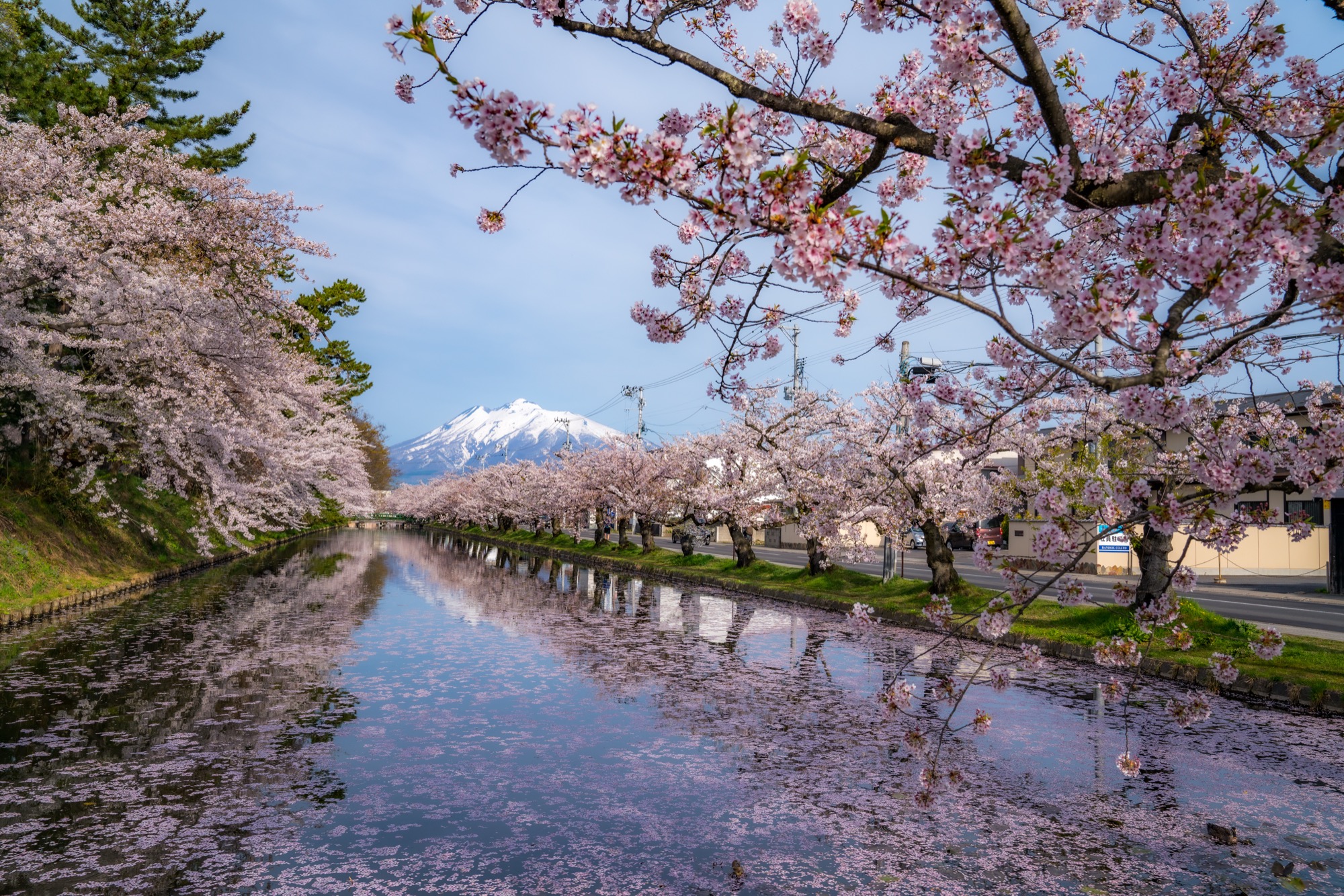
The backdrop matters too. While Tokyo’s blossoms frame subway stations and concrete overpasses, Tohoku’s cherry trees grow against mountains, castle towers, rivers, and traditional samurai architecture. At Hirosaki Castle, the moat reflection frames a centuries-old keep behind a wall of blooms. At Kakunodate, weeping cherries cascade over the earthen walls of samurai residences that look virtually unchanged from the Edo period. The scenery doesn’t feel curated for Instagram — it just happens to be genuinely extraordinary.
Tohoku Cherry Blossom Timing: A Complete Seasonal Calendar
Planning a Tohoku cherry blossom trip requires understanding the timing, which varies significantly across the region and from year to year depending on winter temperatures. As a general guide:
- Sendai & Miyagi Prefecture (late March to mid-April): The Shiroishi River (Hitome Senbonzakura) and Sendai parks typically peak in early-to-mid April, around the same time as Tokyo but about one week behind on average.
- Yamagata Prefecture (mid-April): Miharu Takizakura (Fukushima) and Yamagata’s mountain temples usually peak around the second week of April.
- Iwate Prefecture (late April): Kitakami Tenshochi and Kakunodate typically reach peak bloom in late April, sometimes coinciding with Japan’s Golden Week holiday period (April 29 to May 5).
- Akita Prefecture (late April to early May): Kakunodate’s famous weeping cherries often reach their peak around the same time as the Kitakami trees, late April.
- Aomori Prefecture (early-to-mid May): Hirosaki Castle cherry blossoms are Japan’s last major cherry blossom event, typically peaking between late April and early May — sometimes extending deep into May in cooler years.
The practical implication: if you can only visit Tohoku once in spring, late April to early May is the sweet spot that catches most of the major locations at or near peak bloom. If you’re planning a multi-destination trip, consider starting in Miyagi around April 10-15 and ending in Aomori around May 1-5, following the bloom northward over three weeks.
Important note: Japanese cherry blossom forecasts (released by the Japan Meteorological Corporation in late January each year) are highly accurate and widely covered in English-language media. Check the forecast before booking — the difference between perfect timing and missing the bloom entirely can be as little as three days.
Hirosaki Castle, Aomori: Japan’s Ultimate Cherry Blossom Destination
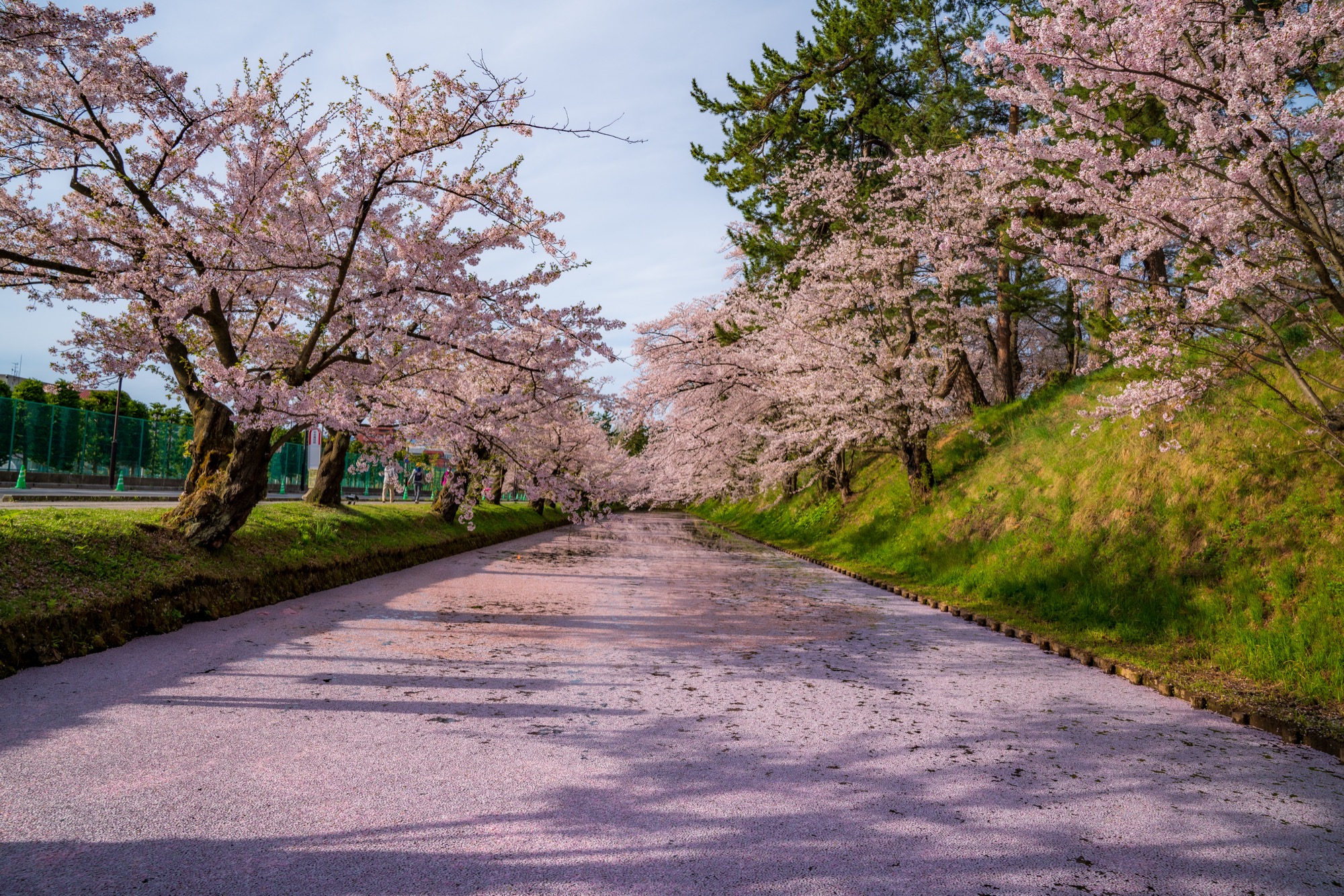
If you visit only one cherry blossom spot in your entire life in Japan, make it Hirosaki Castle. Bold claim, but ask anyone who’s been there: the experience is simply unmatched. The castle grounds contain approximately 2,600 cherry trees, including a remarkable weeping cherry tree believed to be over 130 years old that serves as a landmark for the entire park. But what makes Hirosaki truly extraordinary is the “petal carpet” phenomenon that occurs after peak bloom.
When the petals begin to fall — usually a few days after peak bloom — they accumulate in the castle’s moat faster than the current can disperse them, eventually creating an almost solid surface of pink and white petals floating on the water. Peer down into the moat from the bridge above and you’re looking at what appears to be a floating garden, the petals compressed into an almost abstract painting of pink. This “petal carpet” (hanabira jutan) is considered by many Japanese cherry blossom enthusiasts to be even more beautiful than the peak bloom itself — and since most tourists leave after peak bloom, you’ll often see it with far smaller crowds.
The castle itself is one of only twelve original surviving castle keeps in Japan, a three-story tower that dates to 1611 (though much of the current structure is a reconstruction after an 1810 fire). It’s photogenic in any season, but framed by cherry blossoms it becomes genuinely iconic. The castle grounds are free to enter in normal times, though there’s a paid inner garden area (around ¥310, about $2.10 USD) that provides the best views of the moat and keep together.
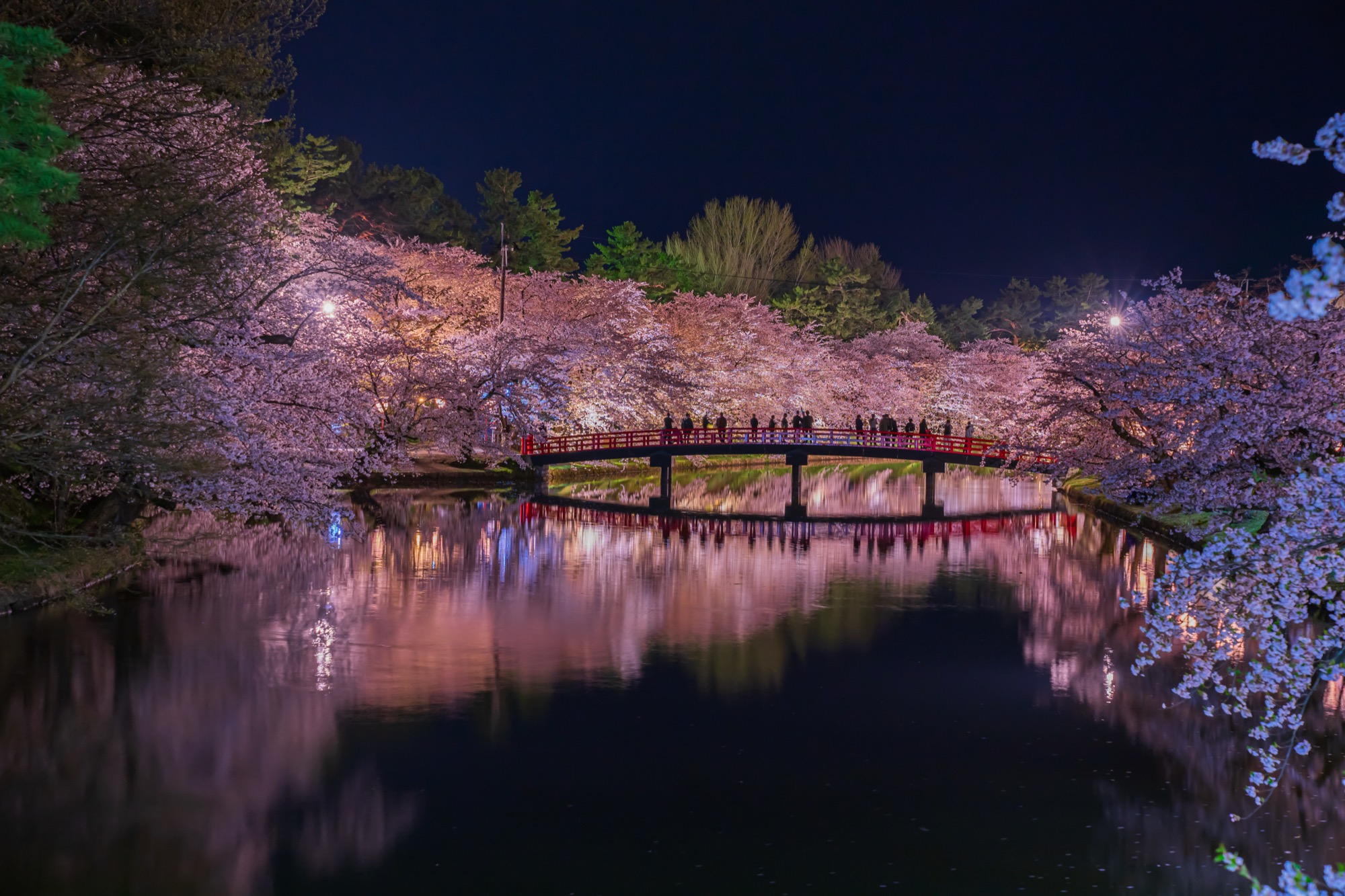
During the festival period (typically late April to early May), the grounds are illuminated at night, creating a magical evening experience as the pink blooms glow against a dark sky. Night viewing (yozakura) at Hirosaki is worth arranging your schedule around — arrive at dusk to catch both the sunset colors and the illuminations switching on.
Getting to Hirosaki: From Tokyo’s Ueno or Omiya stations, take the Tohoku Shinkansen to Shin-Aomori (about 3 hours, ¥17,000-19,000 / approximately $115-130 USD one-way; covered by the JR Pass). From Shin-Aomori, transfer to the JR Ou Line for Hirosaki Station (about 35 minutes, ¥680 / $5 USD). The castle park is a 20-minute walk or short bus ride from Hirosaki Station. Alternatively, there’s limited express service on the JR Tsugaru Line that takes you from Shin-Aomori to Hirosaki more directly on some departures.
Where to stay in Hirosaki: For cherry blossom season, book at least three months in advance — ideally earlier. Hirosaki accommodations fill up quickly for festival dates. The area around Hirosaki Station has a good selection of business hotels in the ¥8,000-15,000 ($55-100) range. For a more atmospheric experience, look for traditional-style inns (ryokan) in the castle district itself, where you might be able to see the illuminated blossoms from your room window.
Kitakami Tenshochi, Iwate: 10,000 Cherries Along the River
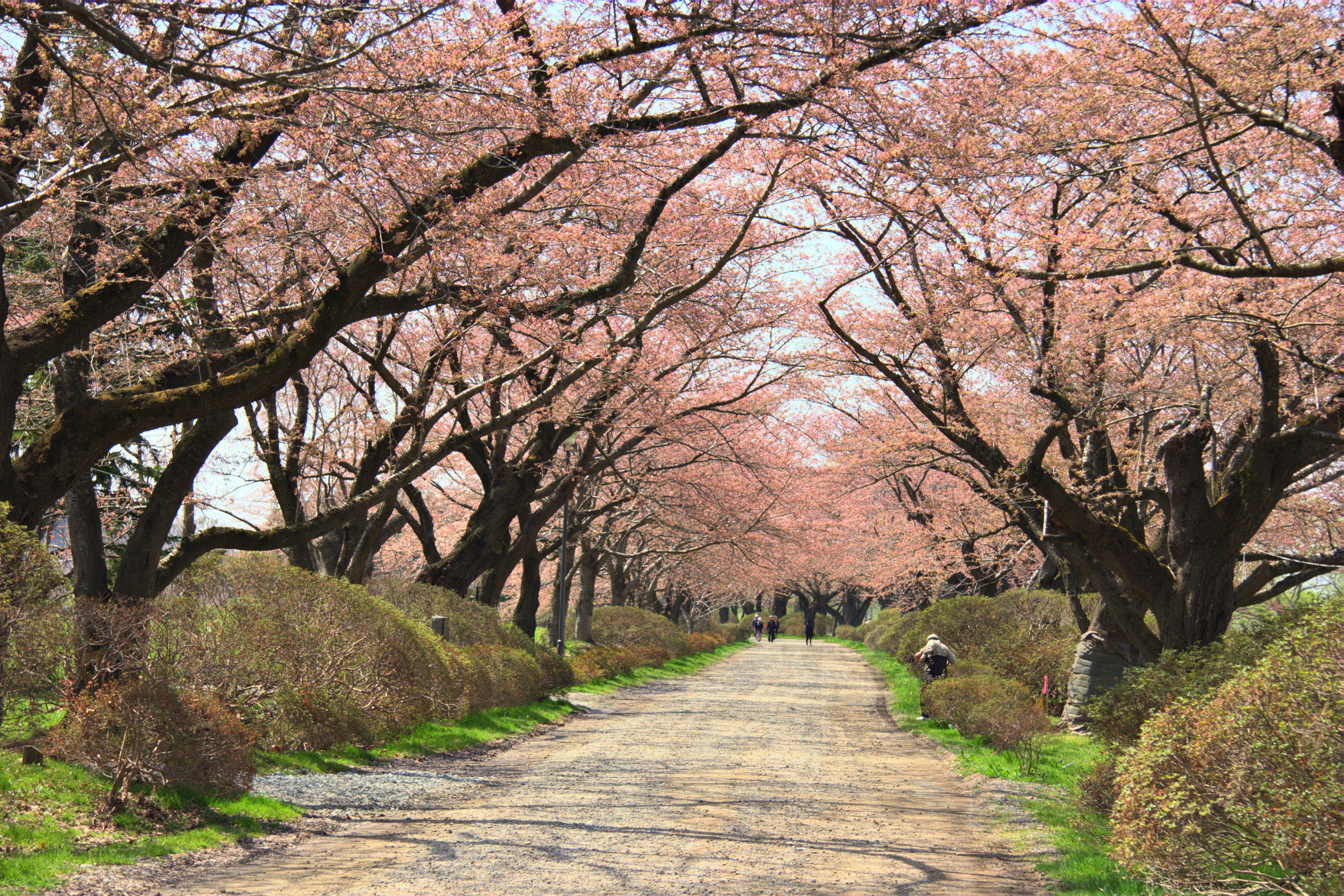
About 60 kilometers south of Morioka, the city of Kitakami sits on the banks of the Kitakami River — and every spring, a 2-kilometer stretch of that riverbank transforms into one of Japan’s most beloved cherry blossom corridors. The Kitakami Tenshochi park (tenshochi means “riverside park”) contains approximately 10,000 cherry trees, predominantly somei yoshino (the standard Japanese cherry variety), that form a continuous canopy over the riverside promenade.
What distinguishes Tenshochi from other multi-tree cherry blossom spots is the combination of scale and setting. Walking the full length of the blooming riverside corridor takes about 30-40 minutes at a relaxed pace, and the experience is immersive in a way that enclosed parks rarely achieve. To your left, the trees arch overhead in an unbroken tunnel of pink; to your right, the Kitakami River flows broad and grey-blue, reflecting the blossoms in its surface. On clear days, the snow-capped peaks of the Ou Mountain Range frame the scene in the distance.
The park is also famous for its combination of Yoshitsune’s Cherry Trees (Yoshitsune-Zakura), ancient cherry specimens believed to be connected to the medieval warrior Minamoto no Yoshitsune’s historic journey through the area. These older, more gnarled trees add a sense of historical depth to what might otherwise be “merely” a gorgeous natural display.
During the Tenshochi Cherry Blossom Festival (typically held over about two weeks in late April), the promenade comes alive with food stalls, traditional performances, and evening illuminations. Unlike Hirosaki’s more tourist-dense festival, Tenshochi maintains a local community feel — most of the hanami parties you’ll see under the trees are Kitakami residents, not tour groups. It’s a wonderful opportunity to observe authentic Japanese hanami culture from up close.
Getting to Kitakami: From Tokyo, take the Tohoku Shinkansen to Kitakami Station (approximately 2.5 hours, ¥13,000-15,000 / about $88-100 USD; JR Pass valid). The Tenshochi park is a 5-minute taxi ride or about 15-minute walk from the station. Alternatively, from Morioka Station, local trains run to Kitakami in about 40 minutes.
Kakunodate, Akita: Cherry Blossoms in the Samurai District
Kakunodate is perhaps the most cinematic of all Tohoku’s cherry blossom destinations — a place where the historical and the natural intertwine in a way that’s hard to replicate anywhere else in Japan. The town’s samurai district (bukeyashiki), which has remained largely unchanged since the Edo period, lines a broad avenue with earthen-walled samurai residences whose gardens spill over onto the street. In cherry blossom season, the shidarezakura (weeping cherry trees) planted by the samurai families centuries ago transform those earthen walls into cascades of deep pink blossoms.
The weeping cherries at Kakunodate are distinctly different from the somei yoshino you’ll see at most Japanese cherry blossom spots. Older, gnarlier, and often a deeper shade of pink or even near-red, these trees have an antiquity and drama that perfectly matches the feudal architecture surrounding them. Many of the individual trees are designated national natural monuments, and some are believed to be descended from trees brought from Kyoto over three centuries ago.
The combination of well-preserved samurai architecture and spectacular flowering trees makes Kakunodate uniquely photogenic. Wander down the main avenue in the morning before the tour buses arrive, and you’ll have the promenade essentially to yourself — just weeping pink cascades framing dark thatched-roof gateways, with the sound of petals falling in the stillness. It’s the kind of scene that makes you understand why the Japanese built an entire aesthetic philosophy around transience and the beauty of things that don’t last.
Beyond the samurai district, Kakunodate’s main river park (Hinokinai River) is lined with somei yoshino trees that create a more conventional but equally beautiful avenue of pink. During peak bloom, a boat tour on the river offers views of the blossoms from the water — a perfect counterpoint to the more intimate samurai district experience.
Getting to Kakunodate: From Tokyo, take the Tohoku Shinkansen to Tazawako Station and transfer to the Akita Shinkansen, which stops at Kakunodate Station (total about 2.5-3 hours from Tokyo, ¥14,000-16,000 / $95-110 USD; JR Pass valid for Akita Shinkansen). From Akita City, local trains serve Kakunodate in about 40 minutes. The samurai district is a 10-minute walk from the station.
Miharu Takizakura, Fukushima: The Ancient Weeping Cherry
Japan has hundreds of famous cherry trees — solo specimens of extraordinary age, beauty, or historical association — but most cherry blossom aficionados agree that the Miharu Takizakura in Fukushima Prefecture stands above them all. The tree’s name translates to “cascading cherry of Miharu,” and the name is entirely literal: a single ancient tree, estimated to be over 1,000 years old, whose branches cascade downward in all directions like a waterfall frozen in spring. Designated a national natural monument, the tree measures 12 meters in height and its branches spread over 20 meters in diameter, the entire mass draped in pale pink flowers every April.
Visiting the Miharu Takizakura is a pilgrimage-style experience rather than a standard sightseeing excursion. The tree stands alone on a hillside above the town of Miharu, accessible via a short walking path from a parking area. During peak bloom (typically early to mid-April), thousands of visitors make the journey daily — the surrounding hillside fills with people, vendors, and food stalls — but even in that crowd, the tree itself has a gravity and presence that silences you as you approach. It’s one of those rare natural phenomena that exceeds all expectations, regardless of how many photographs you’ve seen beforehand.
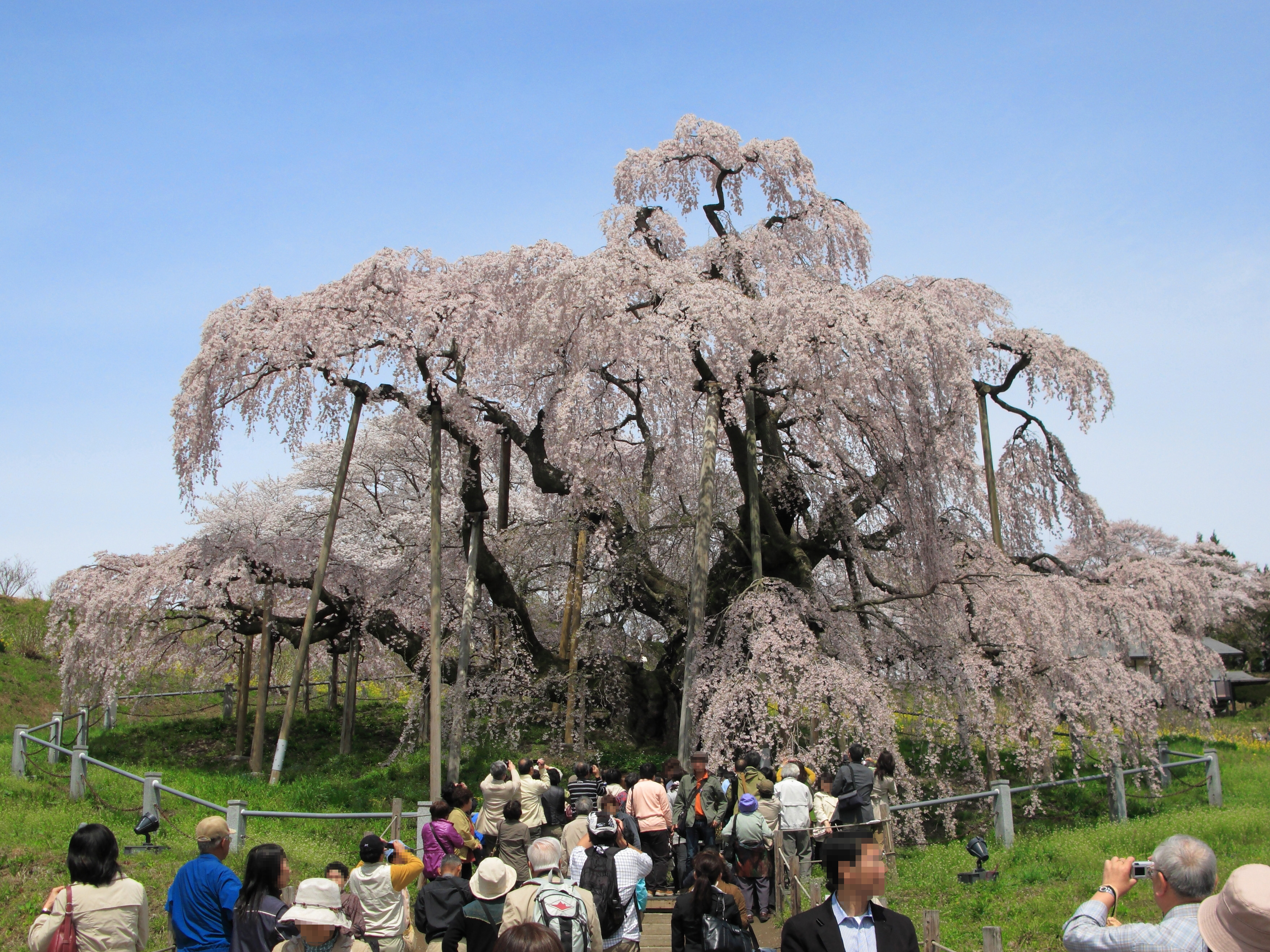
Try to visit on a weekday if possible, and arrive early in the morning (before 9am if you can manage it) — the tree faces east and morning light brings out its colors beautifully, while early arrival means you avoid the full midday crowds. Evening visits (the tree is illuminated during peak bloom) offer a different but equally stunning perspective.
Getting to Miharu Takizakura: The tree is about 5 kilometers from Miharu Station on the JR Ban’etsu East Line. The most practical approach for foreign visitors is usually to rent a car or take a taxi from Miharu Station (about ¥1,500 / $10 USD one-way). Some visitors approach from Koriyama City, the region’s main hub, either by local train to Miharu Station or via rental car (about 25 kilometers from Koriyama). From Tokyo, Koriyama is reachable via Tohoku Shinkansen in about 1 hour 15 minutes (¥8,000-10,000 / $54-68 USD; JR Pass valid).
Sendai’s Cherry Blossoms: Hidden Gems in the City of Trees
Sendai is nicknamed the “City of Trees” (Mori no Miyako), and its wide tree-lined boulevards make it one of Japan’s most pleasant urban environments in spring. While it doesn’t have a single showstopper cherry blossom venue on the scale of Hirosaki or Kitakami, Sendai offers several beautiful spots that are particularly valuable if you’re using the city as a base for wider Tohoku exploration.
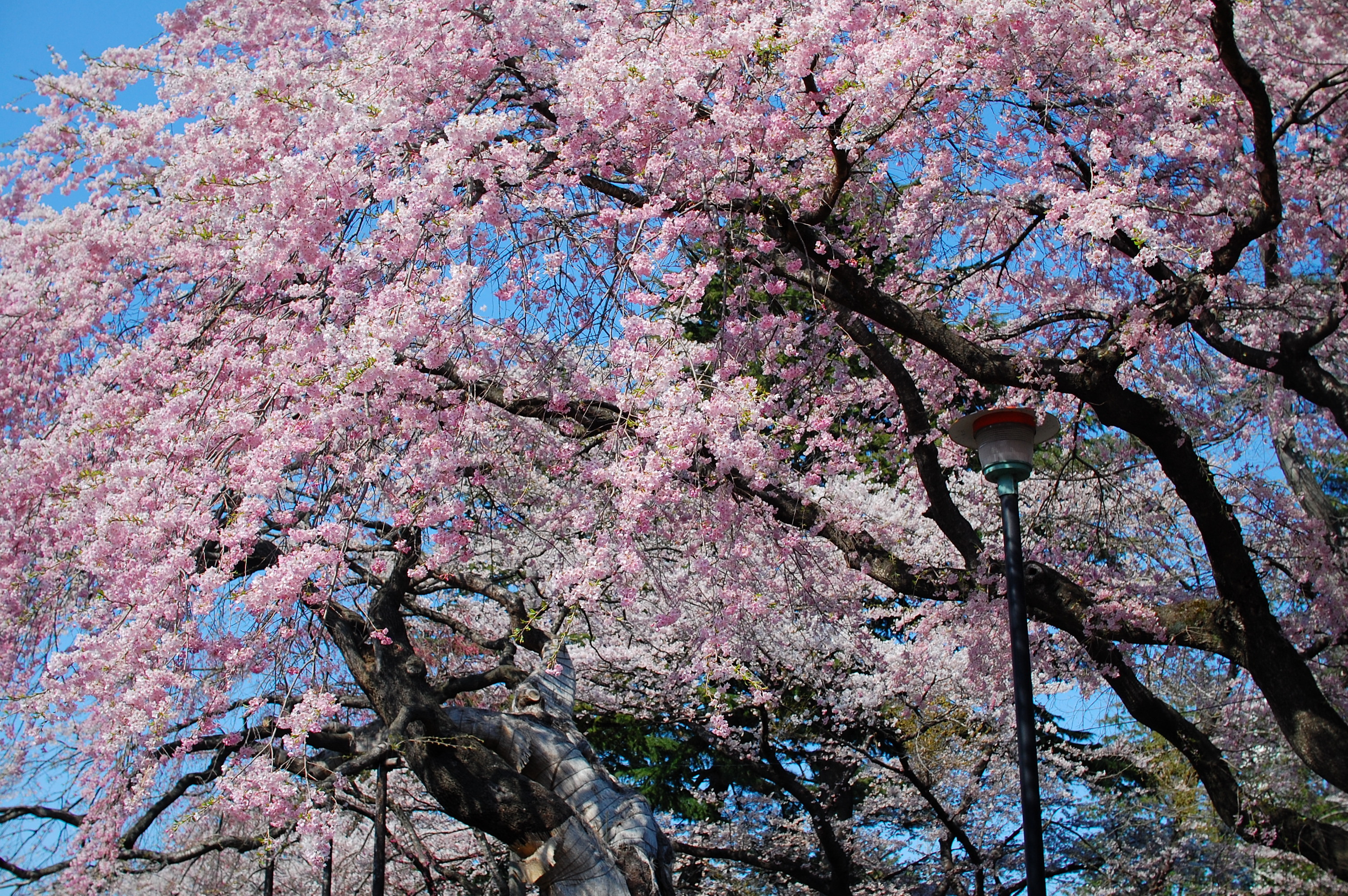
The Nishi (West) Koen park near Sendai Station is the city’s most popular hanami destination — a forested park where hundreds of cherry trees create a classic urban blossom experience, complete with food stalls, picnic parties, and illuminations in the evening during peak bloom. Tsutsujigaoka Park in the Hirose River valley offers a more naturalistic setting, where trees line both banks of the river in a scenic corridor that’s less crowded than the central parks.
Further afield, the Hitome Senbonzakura (“Thousand Cherry Trees at a Glance”) along the Shiroishi River in Miyagi Prefecture, about 40 kilometers south of Sendai, is one of the region’s most famous cherry blossom experiences. Here, approximately 1,200 cherry trees line a 8-kilometer stretch of the Shiroishi River embankment, with the snowcapped peak of Mount Zao providing a dramatic backdrop on clear days. The name comes from the legend that you can see a thousand cherry trees at a single glance from certain vantage points along the bank.
Getting to Sendai: Sendai is the easiest gateway to Tohoku, served directly from Tokyo by Tohoku Shinkansen in about 1.5-2 hours (approximately ¥11,000 / $75 USD; JR Pass valid). The Hitome Senbonzakura area is reachable from Sendai via the JR Tohoku Main Line to Shiroishi-Zao Station, then a bus or taxi (30-40 minutes, about ¥1,500-2,000 / $10-14 USD each way).
Best Time to Visit for Cherry Blossoms
- Late March to early April: Fukushima Prefecture comes alive first — the Miharu Takizakura typically peaks in early April. This is the same window as Tokyo, so if you’re combining both destinations, you can see Fukushima and then move north as Tokyo blooms.
- Early to mid-April: Miyagi Prefecture (Sendai and the Shiroishi River area) peaks. Yamagata Prefecture is also beginning to bloom. Weather can be unpredictable — bring layers.
- Mid-to-late April: Iwate Prefecture (Kitakami, Hiraizumi, Morioka area) reaches peak bloom. This coincides with warmer spring weather and is generally considered the most comfortable time to visit.
- Late April to early May: Akita Prefecture (Kakunodate) and Aomori Prefecture (Hirosaki). This overlaps with Japan’s Golden Week holidays (April 29 – May 5), making accommodation booking extremely competitive. Book 3-6 months in advance for Golden Week travel.
- Early-to-mid May: Even as you head back south, higher altitude spots like Yamadera temple in Yamagata or mountain passes through the Tohoku Alps may still have late-blooming cherries extending into May.
Where to Eat: Spring Specialties During Hanami Season
Cherry blossom season in Tohoku coincides with the arrival of spring ingredients and a general atmosphere of celebration that makes the food scene particularly lively. Here’s what to look for:
Sakura-themed foods
During cherry blossom season, confectionery shops (wagashi stores) across Tohoku put out special spring sweets: sakura mochi (pink rice cakes wrapped in salted cherry leaves), hanami dango (three-colored sticky rice dumplings on skewers — pink, white, and green), and a variety of seasonal wagashi that use edible cherry blossoms preserved in salt. These make beautiful edible souvenirs and perfect hanami picnic snacks — buy them in advance from a department store basement (depachika) or traditional sweet shop before heading to the park.
Hirosaki: Apple & Cider Country
Hirosaki is famous throughout Japan for its apple production — Aomori Prefecture grows over half of Japan’s total apple crop. During cherry blossom season, look for apple cider (ringo juice), apple wine, and apple-flavored confections at festival food stalls near the castle. For a proper meal, try local specialty restaurants around Hirosaki Station for anything featuring local produce: handmade soba, kaiten-sushi with regional fish, or a traditional kaiseki lunch at one of the city’s historic restaurants.
Morioka: The Three Noodles City
If your cherry blossom itinerary takes you through Morioka (the capital of Iwate, close to Kitakami), dedicate at least one meal to the city’s extraordinary noodle culture. Morioka is famous for three distinct noodle dishes: wanko soba (a theatrical rapid-fire dining experience where servers continuously refill your bowl until you ask them to stop), jajamen (a unique Chinese-influenced noodle dish with miso meat sauce), and morioka reimen (cold buckwheat noodles with kimchi, watermelon, and a spicy broth — strange on paper, excellent in practice). All three are available at specialized restaurants within walking distance of Morioka Station.
Kakunodate: Mountain Vegetables & Local Delicacies
Kakunodate sits in the mountains of Akita, and spring is the season for sansai (wild mountain vegetables), which are foraged from the surrounding forests and incorporated into dishes at local restaurants and ryokan. Look for sansai tempura, sansai gohan (mountain vegetable rice), and pickled sansai as side dishes — these seasonal ingredients appear only in spring and represent an authentic taste of the Japanese mountain landscape at its most renewed.
Where to Stay Near the Top Cherry Blossom Spots
Near Hirosaki (Aomori)
Budget (Under ¥8,000 / $54): Hirosaki has several business hotels and guesthouses in the ¥5,000-8,000 range. Look for places near Hirosaki Station for convenient transportation.
Mid-range (¥8,000-20,000 / $54-135): Ryokan in the old town area offer traditional Japanese hospitality within walking distance of the castle. During cherry blossom festival weeks, even mid-range accommodations fill up fast — book 3-4 months ahead.
Luxury (¥20,000+ / $135+): A small number of high-end ryokan in Hirosaki offer premium rooms with castle-district views and kaiseki dinners featuring Aomori’s famous seafood, mountain vegetables, and beef.
Near Kakunodate (Akita)
Budget: Basic business hotels near Kakunodate Station from around ¥6,000 ($40) per night. Limited options — booking early is essential.
Mid-range to Luxury: Kakunodate’s ryokan scene is small but atmospheric, with a handful of inns that occupy renovated traditional buildings in or near the samurai district. These book up entirely for cherry blossom season — if you want to stay in Kakunodate itself during peak bloom, you need to book 4-6 months in advance. Alternatively, stay in Tazawako Onsen (30 minutes away by train) and day-trip to Kakunodate.
Sendai as a Base
Sendai is Tohoku’s largest city and has the region’s widest range of accommodation options, from international-chain business hotels at ¥8,000-12,000 ($54-81) to boutique stays and high-end city hotels. For cherry blossom season, Sendai is an ideal base for day trips to the Shiroishi River area, Yamadera, and even Morioka. The city’s infrastructure, restaurant variety, and transport connections make it the most practical hub for a first-time Tohoku spring visitor.
Practical Tips for Tohoku Cherry Blossom Viewing
- Book early for Golden Week: Japan’s Golden Week holiday (April 29 to May 5) coincides with the peak bloom period for northern Tohoku destinations like Hirosaki and Kakunodate. Accommodation and transport capacity fills up months in advance. If your travel dates overlap with Golden Week, book at least four months ahead.
- Cherry blossom timing is unpredictable: The exact peak bloom date varies by up to two weeks from year to year depending on winter temperatures. Check official forecasts (released by Japan Meteorological Corporation in late January) and follow Japanese weather apps like Tenki.jp for “sakura predictions” as your travel date approaches.
- Morning is best: The most famous spots get crowded by mid-morning, especially on weekends. Arriving before 8am gives you a genuinely magical, crowd-free experience at places like Hirosaki Castle.
- Rain doesn’t ruin it: In fact, cherry blossoms photographed in light rain have a particular beauty — the wet petals glow, the colors deepen, and the crowds thin dramatically. Bring a clear umbrella (available at every Japanese convenience store) and go anyway.
- The petals fall after peak: Don’t be discouraged if you arrive just after peak bloom — the falling petal phase (hanafubuki, “petal blizzard”) and petal carpet phases are beloved in their own right and often more crowd-free.
- Night viewing is worth it: All major cherry blossom spots offer illuminated night viewing (yozakura) during festival periods. The evening light creates a completely different atmosphere from the daytime — more intimate, more magical, and often less crowded than the busiest daytime hours.
- Wear layers: Cherry blossom season in Tohoku means temperatures ranging from 5°C (41°F) at night in the north to 18°C (64°F) on warm afternoons in the south. Dress in layers you can add or remove throughout the day.
- Bring picnic supplies: Hanami is fundamentally a picnic activity. Stop at a convenience store or depachika (department store basement food hall) for onigiri, sandwiches, sakura-flavored drinks, and seasonal treats. Blue tarps for sitting under the trees are ubiquitously available at convenience stores during hanami season (¥300-500 / about $2-3 USD).
- Respect the trees: Don’t climb on, break, or shake cherry trees to make petals fall — this is genuinely frowned upon in Japan and can damage trees that may be hundreds of years old.
- Download Tabelog: For finding restaurants near cherry blossom spots, the Tabelog app (or website, accessible in English through Google Translate) gives real-time ratings and menus for local restaurants. Particularly useful in smaller towns where English signage is limited.
Sample 7-Day Tohoku Cherry Blossom Itinerary
This itinerary is designed for late April to early May, catching the peak bloom period for the northern Tohoku destinations while also exploring the unique cultural offerings of the region.
Day 1: Tokyo to Fukushima (Miharu)
Take an early Tohoku Shinkansen from Tokyo to Koriyama (about 1 hour 15 minutes). From Koriyama, transfer to the Ban’etsu East Line for Miharu Station, then taxi to the Takizakura tree. Spend two to three hours at and around the tree, then return to Koriyama for the night. Dinner: Koriyama’s excellent izakaya scene around the station.
Day 2: Fukushima to Sendai
Morning shinkansen from Koriyama to Sendai (about 35 minutes). Check into your Sendai accommodation and spend the afternoon at Nishi Koen park or the Hirose River. In the evening, explore Sendai’s Ichibancho shopping and restaurant district — one of Tohoku’s most vibrant. Dinner: Gyutan (beef tongue), Sendai’s signature dish.
Day 3: Sendai — Shiroishi River Day Trip
Day trip to the Hitome Senbonzakura (Shiroishi River) by local train — about 40 minutes each way. Arrive early for the morning light along the riverbank. Return to Sendai in the afternoon and explore the city’s temples and markets. Evening: Tanabata Decorations museum or the Sendai Mediatheque cultural center.
Day 4: Sendai to Morioka (via Kitakami)
Morning shinkansen from Sendai to Kitakami (about 45 minutes). Spend the morning at Tenshochi Cherry Blossom Park. Afternoon shinkansen to Morioka. Evening: wanko soba dinner experience and a walk along the Kitakami River in central Morioka.
Day 5: Morioka to Kakunodate
Morning train from Morioka to Kakunodate via Tazawako Station (about 1 hour 15 minutes). Spend the day in Kakunodate’s samurai district — morning in the bukeyashiki, afternoon along the Hinokinai River. Stay overnight in Kakunodate or nearby Tazawako Onsen for a traditional inn experience.
Day 6: Kakunodate to Hirosaki
Train from Kakunodate to Hirosaki via Akita City (approximately 2.5 hours). Arrive at Hirosaki Castle by mid-afternoon for evening cherry blossom viewing and the night illuminations. Stay overnight in Hirosaki — book well in advance.
Day 7: Hirosaki and Return
Early morning at Hirosaki Castle before the crowds. Explore Hirosaki’s city center, including the Hirosaki Park outer grounds and the apple-themed shops and cafes. Afternoon shinkansen from Shin-Aomori back to Tokyo (about 3 hours). Total journey: approximately ¥40,000-50,000 ($270-340 USD) in transport costs one-way from Tokyo; accommodation adds roughly ¥8,000-15,000 ($54-100) per night depending on choices.
Final Thoughts: Why Tohoku’s Cherry Blossoms Deserve a Special Journey
Japan’s cherry blossom season is one of the world’s great natural events, but Tohoku’s version of it is something special — slower, deeper, less performatively touristic than its counterparts further south. Here, the blossoms still feel like they belong to the people who have lived under them for generations. The older trees carry the weight of centuries, and the combination of natural beauty with historical architecture, mountain backdrops, and genuine local traditions creates an experience that stays with you long after the petals have fallen.
Whether you’re chasing the ancient Miharu Takizakura, walking the samurai lanes of Kakunodate, or standing at Hirosaki Castle at dawn watching the petal carpet form on the moat below — Tohoku in cherry blossom season is one of Japan’s truly unmissable experiences. Start planning early, check the forecasts as your travel date approaches, and trust that it will be worth the journey.
Have questions about planning your Tohoku cherry blossom trip, or spots we didn’t cover? We’d love to hear from you — drop us a message here.
Related Articles You Might Enjoy
- Tanesashi Coast & Kabushima Island, Aomori: Japan’s Most Dramatic Coastal Walk & Seabird Sanctuary
- Hirosaki City Guide: Apple Capital, Neputa Festival & Aomori’s Most Historic Castle Town
- Resort Shirakami Scenic Train Guide: Japan’s Most Beautiful Railway Journey Through Aomori
- Shirakami-Sanchi Beech Forest, Aomori & Akita: Complete Guide to Japan’s Ancient UNESCO Wilderness
- Towada Art Center & Towada City: Where Contemporary Art Meets Rural Japan



コメント