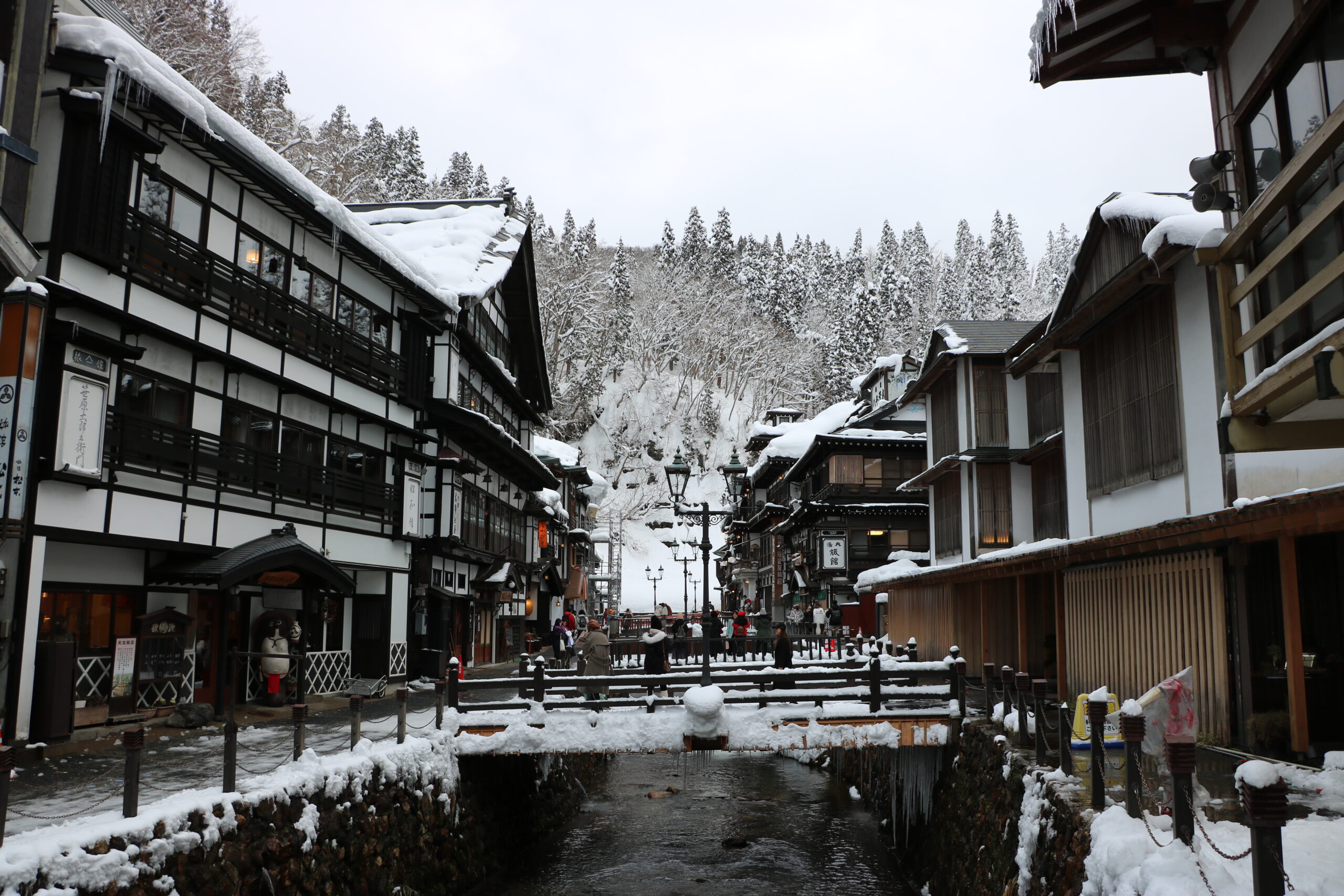
Japan has over 27,000 hot spring sources — more than almost any other country on Earth — and Tohoku, the northeastern region, is where some of the country’s finest onsen are hiding. Away from the crowds of Hakone and Beppu, Tohoku’s hot spring villages are quieter, more atmospheric, and in many cases, steeped in centuries of tradition that you simply don’t get at Japan’s more commercialized onsen resorts. Whether you’re dreaming of a milky-white outdoor pool surrounded by snow-draped pines, a lantern-lit riverside inn straight out of a Studio Ghibli film, or a communal bath the size of a swimming pool in a cedar-wood bathhouse, Tohoku delivers it all — and then some.
Why Tohoku is Japan’s Best Onsen Region (That Nobody Talks About)
Ask most foreign visitors to Japan where the best hot springs are, and they’ll say Hakone (convenient from Tokyo), Beppu (famous for its variety), or maybe Kyushu in general. Tohoku rarely makes the list — and that’s exactly what makes it so remarkable. The region has been producing some of Japan’s finest spring water for centuries, and its distance from the major tourist circuits means you can still find outdoor baths where you’ll be the only foreigner, ryokan where the proprietress learned her trade from her grandmother, and hot spring water in colors that look chemically impossible: bright white, deep amber, pale turquoise, and vivid yellow-green.
Tohoku’s volcanic geography is the foundation of everything. The Pacific Ring of Fire runs directly through northeastern Japan, and the Ou Mountain Range — the backbone of Tohoku — is dotted with active and dormant volcanoes that push mineral-rich water to the surface at extraordinary temperatures. The resulting springs vary enormously in their chemical composition: sulfurous springs with milky-white water, sodium bicarbonate springs with silky-smooth water that leaves your skin feeling extraordinary, iron-rich springs with reddish-brown water, and chloride-rich springs with the concentrated mineral content of the sea.
This guide covers the best of Tohoku’s onsen — the legendary names, the hidden gems, what to expect at each, how to get there, and what you need to know to make the most of the experience as a foreign visitor. Let’s get into the water.
Ginzan Onsen, Yamagata: Japan’s Most Beautiful Hot Spring Town
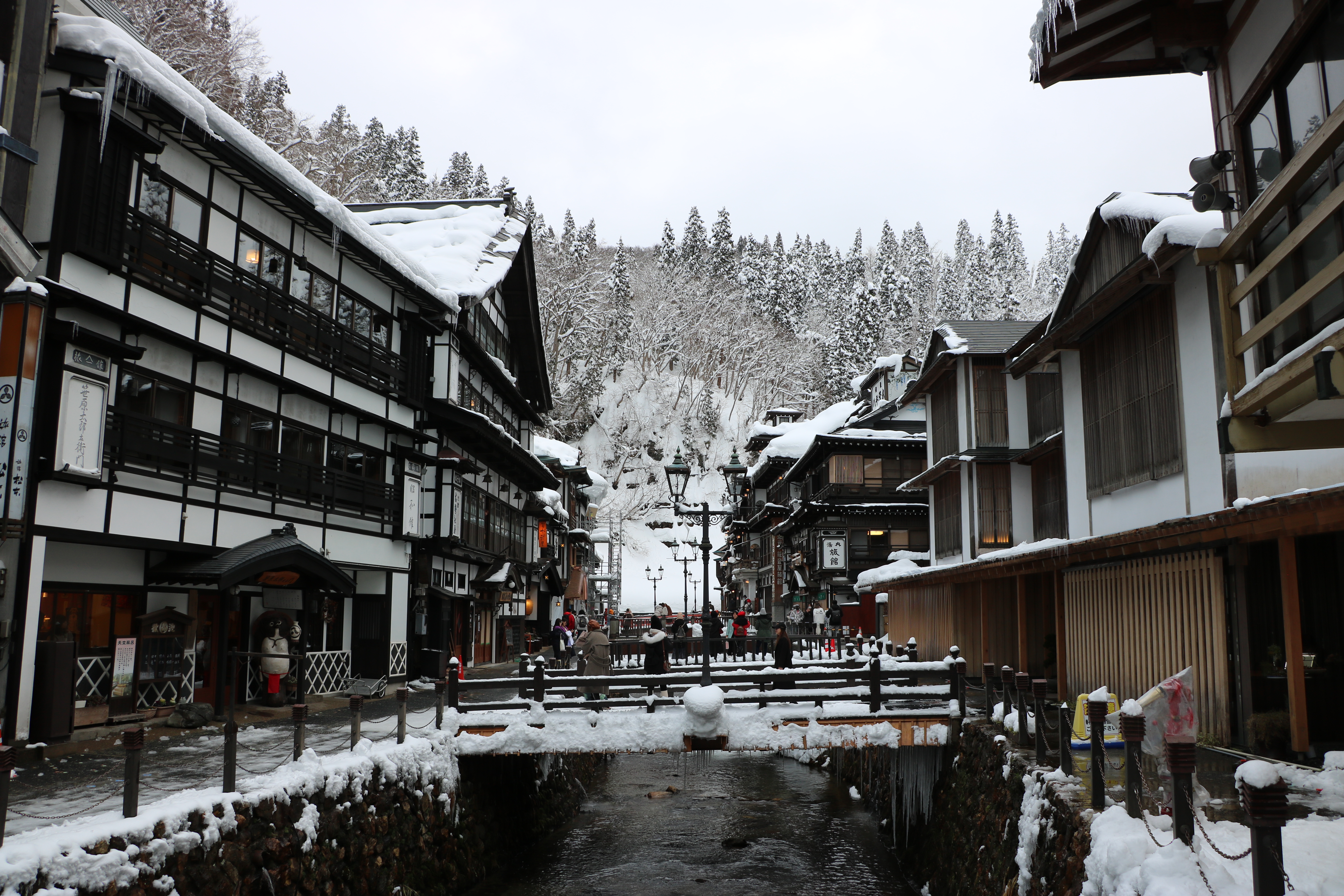
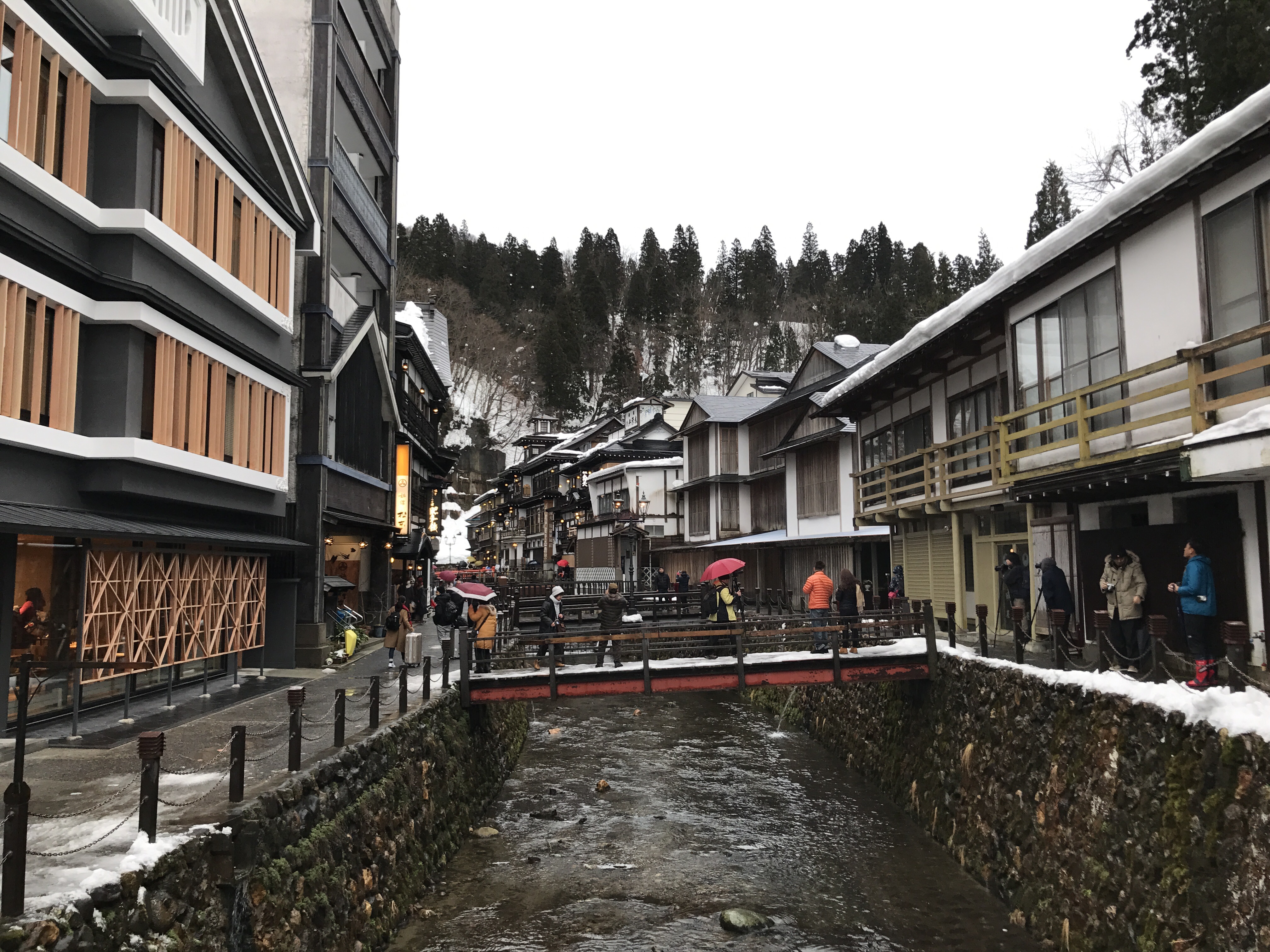
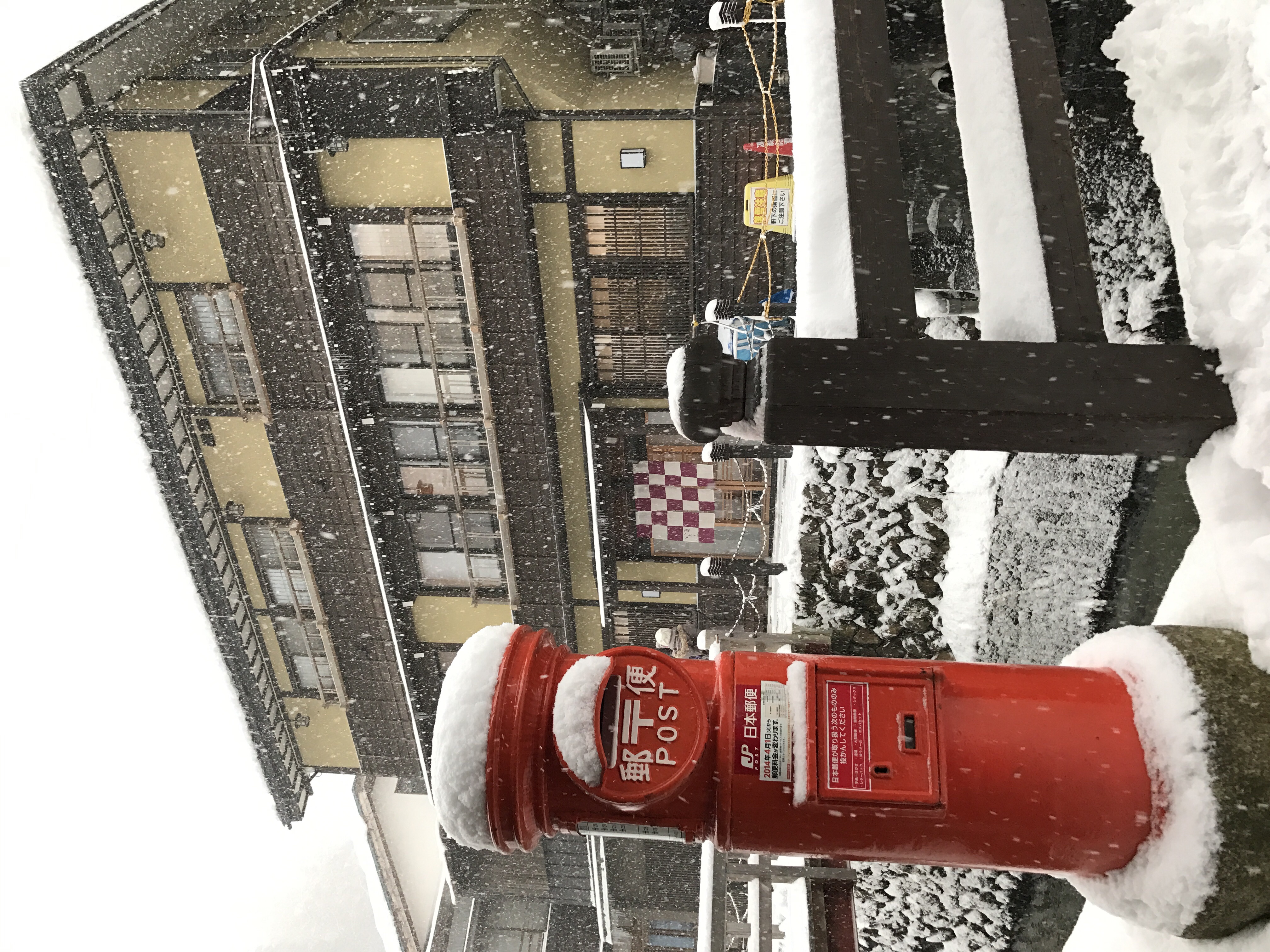
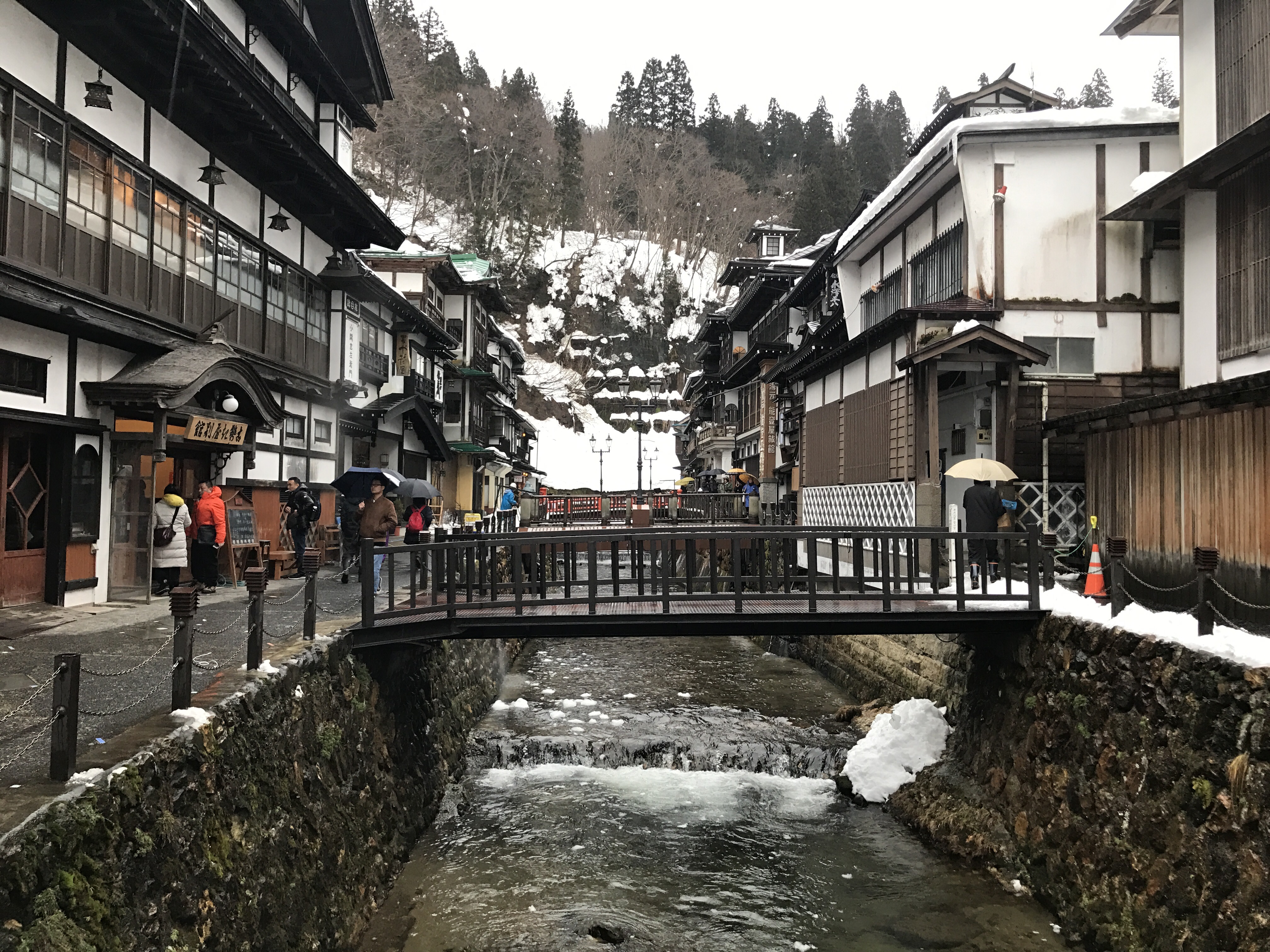
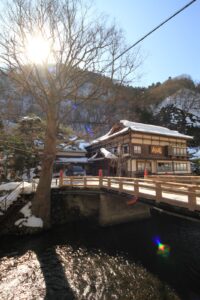
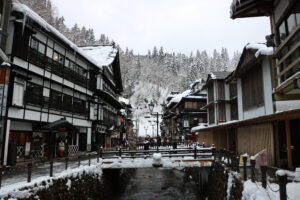
If you could only visit one onsen destination in Tohoku, make it Ginzan Onsen. Located in the mountains of Yamagata Prefecture, this small hot spring village — about 15 establishments clustered along a narrow river gorge — is so visually stunning that it barely looks real. In winter, with snow blankets on the rooftops of wooden Taisho-era ryokan, gas lamps reflecting on the frozen river, and the steam rising from outdoor baths visible above the treeline, it’s the most breathtaking single scene in all of Tohoku.
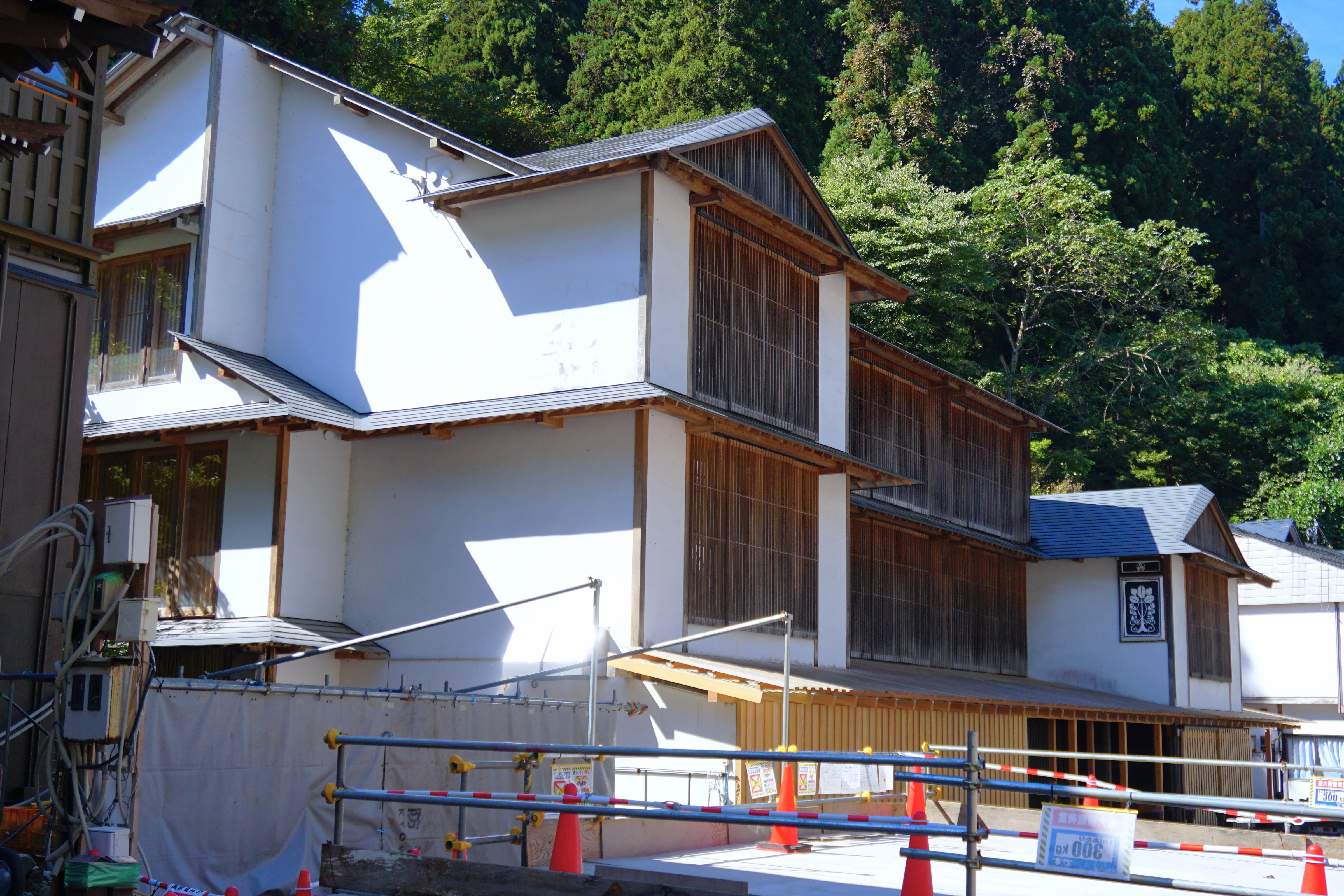
Ginzan Onsen (the name means “silver mountain hot spring”) grew up around a silver mine in the 16th century, and the architecture reflects its prosperous past: the ryokan buildings are multi-story wooden structures in a distinctive style called “Taisho Roman” (influenced by the early 20th century Taisho period’s blend of Western and Japanese design), with overhanging eaves, wooden lattice windows, and ornate facades. The most famous building, Fujiya Ryokan, is said to have inspired the legendary bathhouse in Hayao Miyazaki’s Studio Ghibli film “Spirited Away” — which means visiting Ginzan Onsen doubles as a pilgrimage for anime fans.
The springs at Ginzan produce colorless, slightly salty water that is excellent for the skin. Most ryokan have both indoor and outdoor baths, and the outdoor baths (rotenburo) overlooking the river are the most coveted spots. The water temperature is typically around 42-44 degrees Celsius (108-111 degrees Fahrenheit).
Getting there: Ginzan Onsen is approximately 4 hours from Tokyo by Shinkansen (to Yamagata Station) plus a local bus or taxi. From Yamagata Station, take a local JR train to Oishida Station (about 30 minutes), then a bus to Ginzan Onsen (approximately 45 minutes, ¥900 / $6). Alternatively, a direct bus from Yamagata Station to Ginzan Onsen runs on weekends and costs around ¥1,100 ($7.50).
Day tripping vs. staying overnight: Ginzan Onsen is far more rewarding as an overnight stop. Day visitors can use public outdoor foot baths (free), and some ryokan offer day bathing (higoyu) for around ¥500-¥1,500 ($3.50-$10), but the full experience — arrival in the late afternoon, a multi-course kaiseki dinner, morning bath, and breakfast — is something else entirely. Ryokan rates range from about ¥18,000-¥60,000 ($120-$410) per person including two meals.
Nyuto Onsen Village, Akita: Seven Springs in the Forest
Deep in the mountains of Akita Prefecture, about 17 kilometers from Lake Tazawa, lies a collection of seven hot spring inns that together form one of Japan’s most beloved and atmospheric onsen destinations. Nyuto Onsen doesn’t have the picture-perfect visual drama of Ginzan Onsen — there’s no charming village streetscape — but what it offers instead is something rarer: genuine remoteness, extraordinary spring water variety, and a connection to the natural world that feels almost primal.
Each of the seven inns at Nyuto Onsen draws from its own spring source, with water chemistry that varies significantly from one property to the next. This variation is part of what makes the area so compelling for onsen enthusiasts, who sometimes spend several days working their way through all seven:
- Tsurunoyu (Crane’s Bath): The most famous and photographed, Tsurunoyu has been welcoming guests for over 350 years. The milky-white water of its famous outdoor mixed-gender bath (konyoku) — a large pool set among rocks, with a thatched roof shelter on one side — is rich in sulfur and carbonic acid. Day bathing: ¥800 ($5.50). Overnight from ¥22,000 ($150) per person with meals.
- Magoroku Onsen: Rustic and deeply traditional, set in dense cedar forest. The spring is iron-rich, producing brownish water with a slightly metallic character. Quieter and less touristy than Tsurunoyu. Day bathing available.
- Ganiba Onsen: Famous for its outdoor pool overlooking a mountain stream. The water has excellent skin-softening properties. Day bathing: ¥500 ($3.50).
- Kuroyu Onsen: The most remote of the seven, accessible only by shuttle bus or on foot. Dark, brownish water from a sulfur-iron spring. No day bathing — overnight guests only.
The Nyuto Onsen area offers a shared bathing pass (Yumeguri-cho) for about ¥1,800 ($12), valid for one use at each of the seven inns. This is excellent value if you’re day-tripping and want to sample multiple springs.
Getting there: Take the Akita Shinkansen to Tazawako Station, then a regional bus toward Nyuto Onsen (several times daily, about 35 minutes, ¥750 / $5 one-way). Rental cars from Tazawako Station give more flexibility.
Naruko Onsen, Miyagi: Kokeshi Country and Five Spring Types
Naruko Onsen is one of the largest hot spring resort areas in Tohoku, located in the Osaki area of Miyagi Prefecture, about 2 hours northeast of Sendai. What makes Naruko unique among Japanese onsen is its extraordinary spring diversity: within the greater Naruko area, there are five distinct types of spring water — a range found nowhere else in Japan in such a concentrated area. These include sodium chloride springs, sulfur springs, sodium bicarbonate springs, iron springs, and others, each with different therapeutic properties.
Naruko Onsen is also the historic heart of kokeshi doll culture. These simple, limbless wooden dolls with painted faces and brightly colored designs have been made in the Naruko area for over 180 years, originally as gifts for children and later as collector’s items. The town has a dedicated Kokeshi Museum (Nihon Kokeshi-kan) where you can see hundreds of traditional examples, and several workshops offer hands-on kokeshi painting experiences — a wonderful souvenir activity that takes about 30-45 minutes and costs around ¥1,500-¥2,500 ($10-$17).
The main town of Naruko Onsen has several public baths open to all visitors, including Taki-no-yu, a historic bathhouse offering gender-separated indoor baths in a beautiful wooden building for just ¥150 ($1) per person — exceptional value. The more famous Naruko Gorge (Naruko Kyo), a dramatic river gorge with autumn foliage that rivals anywhere in Japan, is just a few kilometers away and makes an excellent addition to any Naruko onsen visit.
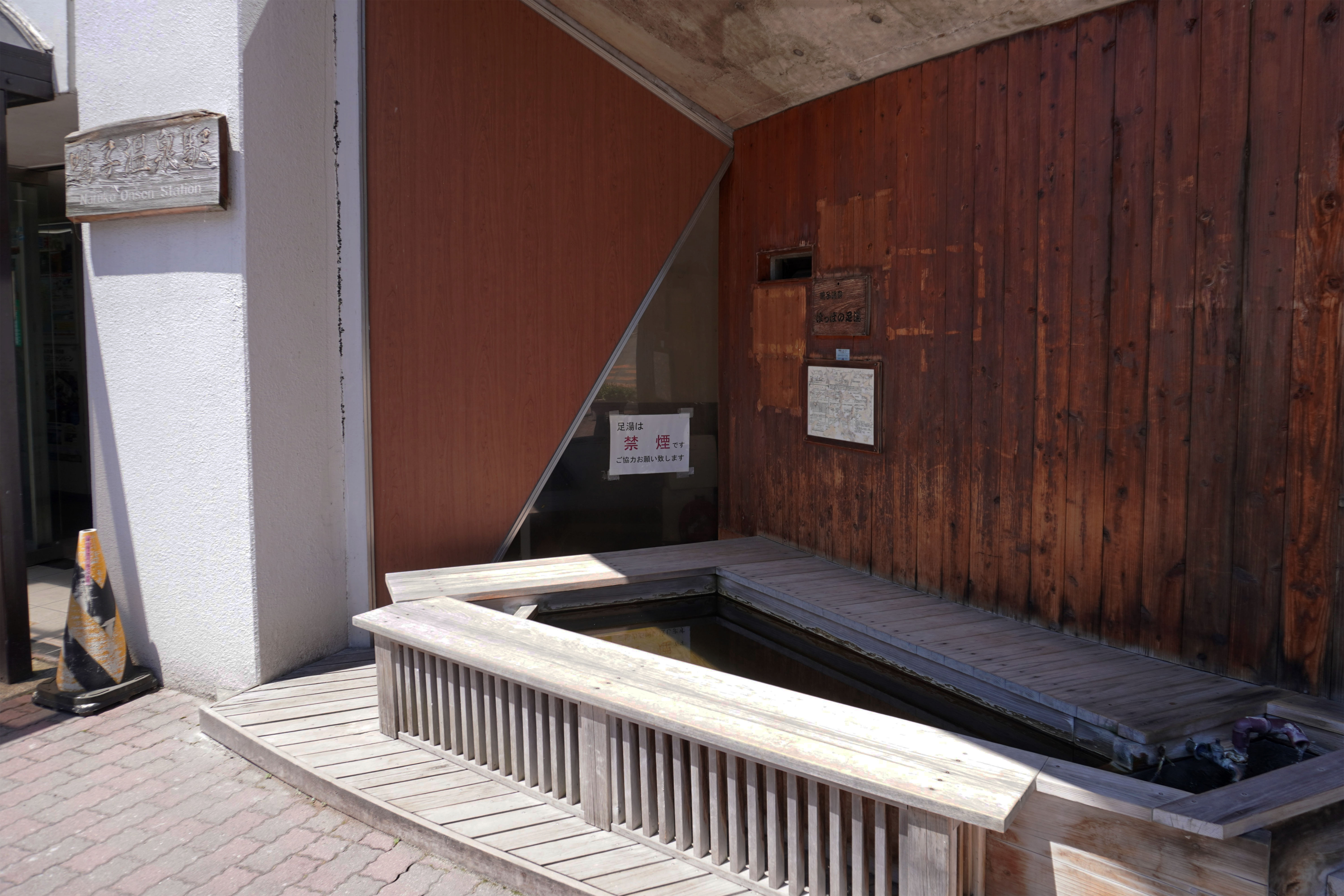
Getting there: From Sendai Station, take the JR Tohoku Main Line to Kogota Station, then transfer to the JR Rikuu-to Line (Rikuutosen) to Naruko Onsen Station. Total journey time is about 90 minutes. The Rikuu-to Line is covered by the JR Pass.
Sukayu Onsen, Aomori: Japan’s Grandest Cedar Bathhouse
Sukayu Onsen, located high in the mountains of Aomori Prefecture near the Hakkoda mountain range, is one of Japan’s most historic and architecturally remarkable onsen. The property’s centerpiece is the Sennin-buro (literally “bath of a thousand people”), an enormous mixed-gender communal bath set inside a massive cedar-wood building with high ceilings and eight spring water outlets feeding the pool — a bathing space so large and so old (the current building dates to 1927) that stepping inside feels like entering another era entirely.
Sukayu’s spring water is a pale milky-white from dissolved hydrogen sulfide, and it has a distinctly sulfurous smell that traditional onsen enthusiasts consider a mark of excellent water quality. The spring is classified as one of Japan’s 100 Famous Onsen (Nihon Hyaku-meito) — an official recognition that Sukayu takes great pride in. The Sennin-buro is gender-mixed (konyoku), a traditional practice that’s increasingly rare in modern Japan; there is a separate women-only indoor bath for those who prefer privacy.
Sukayu is particularly famous for its winter access: it sits at an altitude of 900 meters (2,950 feet) and receives extraordinary snowfall — typically 3-4 meters (10-13 feet) per winter season — and the surrounding Hakkoda mountains are one of Japan’s top skiing destinations. The combination of world-class powder skiing at Hakkoda and a soak in Sukayu’s legendary bathhouse makes this one of the best winter experiences in all of Japan.
Getting there: Sukayu Onsen is about 90 minutes from Aomori Station by bus. The JR bus runs several times daily and costs approximately ¥1,130 ($7.50). In winter, the road can be challenging — check conditions before traveling.
Zao Onsen, Yamagata: Snow Monsters and Hot Springs
Zao Onsen sits at an altitude of 880 meters (2,890 feet) on the slopes of Zao, an active volcanic mountain on the Yamagata-Miyagi border. It’s best known internationally for the phenomenon of “snow monsters” (juhyo) — trees coated in thick, otherworldly ice formations during the winter months — but Zao’s hot spring credentials are impeccable in their own right. The onsen town has dozens of ryokan, hotels, and public baths, making it one of the largest onsen resort areas in Tohoku.
The spring water at Zao is highly acidic — more acidic than lemon juice — and has a distinctive yellowish tinge. It’s one of Japan’s strongest acidic springs, and its reputation for skin-related health benefits is well-established. However, this same acidity means you should shower thoroughly after bathing and avoid having it in your eyes. The most famous public bath is the Zao Onsen Dai-yu (Central Bath), a beautiful traditional facility open to day visitors for ¥550 ($3.75).
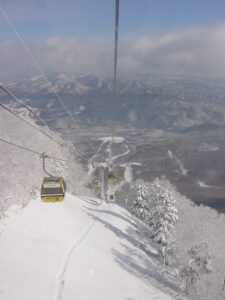
In winter, Zao becomes one of Tohoku’s premier ski resorts, with excellent terrain for all ability levels. The combination of morning skiing through the snow monster forest, followed by an afternoon soak in the hot springs, followed by a kaiseki dinner at a hillside ryokan, is a quintessential Tohoku winter experience.
Getting there: From Yamagata Station, take the Zao Onsen Bus (about 40 minutes, ¥1,050 / $7). From Tokyo, take the Yamagata Shinkansen to Yamagata Station (about 2 hours 40 minutes) and then the bus.
Hanamaki Onsen, Iwate: Relaxation in Kenji’s Country
The Hanamaki area of Iwate Prefecture is famous as the birthplace of Kenji Miyazawa, one of Japan’s most beloved poets and writers. But it’s also home to a cluster of excellent hot spring resorts that make excellent bases for exploring the wider Iwate region — including the folk village of Tono, the city of Morioka, and the scenic Geibikei Gorge.
Hanamaki Onsen is technically a cluster of several distinct hot spring areas, including Osawa Onsen, Namari Onsen, and Dai-Onsen, each with its own character. Osawa Onsen is particularly famous for its mixed-gender outdoor baths set in a picturesque valley, open year-round and accessible to day visitors for a modest fee. The springs here produce sodium sulfate water known for its skin-softening properties.
For travelers using Tohoku as a base, Hanamaki’s position on the Tohoku Shinkansen line (just 15 minutes from Morioka) makes it an extremely convenient overnight stop — you can arrive in the evening, onsen, sleep, and be in Morioka or continuing north by mid-morning.
Onsen Etiquette: Everything Foreign Visitors Need to Know
Japanese onsen culture has some rules that can feel intimidating for first-timers, but they’re easy once you know them. Here’s everything you need to navigate Tohoku’s hot springs confidently:
The Tattoo Question
This is the most frequently asked question among foreign visitors. Many traditional onsen in Tohoku do not permit guests with visible tattoos to use communal baths — a policy stemming from historical associations between tattoos and organized crime. In practice, policies vary significantly. Some strict ryokan and public baths will turn you away; others have private rental baths (kashikiri buro) available to anyone; others are relaxed about small or discreet tattoos, especially for foreign visitors. Always check the onsen’s policy when booking. This guide includes notes on tattoo-friendly facilities where known.
Washing Before You Enter
The absolute cardinal rule of Japanese onsen: shower thoroughly before entering the communal bath. Every onsen has shower stations (showers, taps, stools, and soap/shampoo) that you must use to clean yourself before getting in the water. This keeps the bath water clean for everyone. Forgetting this step is the most common mistake made by first-time visitors and will get you some meaningful looks from other bathers.
No Swimwear in the Bath
Japanese onsen are bathed in the nude — swimsuits are not permitted in traditional communal baths. A small towel is provided for modesty when walking to and from the bath; this towel is kept out of the water (placed on your head or at the side of the bath).
Indoor vs. Outdoor Baths
Most ryokan and onsen facilities have both indoor baths (naiyu) and outdoor baths (rotenburo). The outdoor baths — where you soak in natural hot spring water open to the sky, often surrounded by forest, mountains, or snow — are generally considered the premium experience and are what Tohoku is most famous for. Don’t miss the outdoor bath even if the indoor one is also excellent.
Timing Your Bathing
At ryokan, baths are typically open from late afternoon through the evening and again in the early morning. Many guests take a bath before dinner and again before breakfast — this is the traditional way and highly recommended. The early morning bath in particular, when the light is soft and the crowds are minimal, is one of the finest simple pleasures Japan offers.
Mixed-Gender Bathing (Konyoku)
Several of Tohoku’s most famous onsen — including Tsurunoyu at Nyuto Onsen and Sukayu Onsen’s Sennin-buro — maintain the traditional konyoku (mixed-gender bathing) practice. This can feel unfamiliar to Western visitors but is treated completely matter-of-factly in Japanese culture. Women typically enter the mixed bath wrapped in a towel or bathing wrap (yuami-gi), which is provided by the facility.
Best Time to Visit Tohoku Onsen
- Winter (December to March): The definitive season for Tohoku onsen. Snow transforms the ryokan and forests into scenes of extraordinary beauty, and the contrast of cold winter air against hot spring water is an almost spiritual experience. Ginzan Onsen in particular is at its most magical, and Nyuto Onsen’s forest baths surrounded by snow are unforgettable. Book well in advance — winter weekends fill up quickly.
- Spring (April to May): Cherry blossom season brings vivid color to the mountains and gardens surrounding Tohoku’s onsen. The crowds from hanami (flower viewing) are slightly higher, but the combination of pink blossoms and hot spring steam is one of Japan’s most beautiful seasonal contrasts.
- Autumn (September to November): Autumn foliage is stunning in the mountains around most of Tohoku’s onsen areas — particularly at Naruko Gorge and around Nyuto Onsen. Mid-October is peak foliage season. This is arguably the busiest tourist season overall, so book accommodation early.
- Summer (June to August): The least popular season for onsen, but summer has its own charms — lush green mountain scenery, cooler evenings that make the outdoor baths comfortable even in warm weather, and significantly fewer crowds than winter or autumn. Some outdoor baths are especially enjoyable in a summer rainstorm.
Onsen Accommodation: Ryokan vs. Hotel
Staying at a traditional Japanese ryokan (inn) is the ideal way to experience Tohoku’s hot springs, and it’s a complete experience in itself — not just a place to sleep. A traditional ryokan stay includes:
- Yukata (cotton robe): Provided in your room, worn for the evening, for bath visits, and in some establishments for wandering the grounds or even the town. The sight of guests in yukata drifting between buildings at a traditional onsen inn is quintessentially Japanese.
- Kaiseki dinner: A multi-course meal showcasing the finest local seasonal ingredients, served in your room or a private dining area. At Tohoku’s better ryokan, this alone is worth the price of admission — dishes may include local mountain vegetables, fresh river fish, wagyu beef, local seafood, and a selection of regional sake.
- Japanese breakfast: The following morning, another multi-course meal — typically miso soup, grilled fish, pickles, rice, egg dishes, and seasonal vegetables. Japanese ryokan breakfast is one of the most satisfying meals in the world, especially after an early morning bath.
Ryokan rates in Tohoku typically start around ¥15,000 ($100) per person including two meals at the lower end, rising to ¥60,000+ ($410+) per person at the most prestigious establishments. Prices are always quoted per person, not per room, and include dinner and breakfast.
Practical Tips for Tohoku Onsen
- Book in advance, especially for winter. The best ryokan in Ginzan Onsen and Nyuto Onsen fill up 3-6 months ahead during peak winter and autumn seasons. Use Jalan, Rakuten Travel, or direct booking (often in Japanese only for smaller inns — Google Translate helps).
- Check the tattoo policy when booking. Don’t assume — call or email ahead if you have tattoos. Many ryokan now have private baths available that can be rented regardless of tattoo status.
- Bring cash. Many onsen establishments in Tohoku, especially smaller family-run ryokan, are cash only or have limited card acceptance. Withdraw yen before departing major cities.
- Don’t drink the water. Unless clearly marked as drinking water, onsen water is not for drinking. Some springs have extremely high mineral concentrations that can be harmful if consumed.
- Stay hydrated. Soaking in hot water is dehydrating. Drink water (not alcohol) before and after bathing. Most ryokan provide bottled water or tea in rooms.
- Try a morning bath. If staying overnight at a ryokan, always take the early morning bath — typically before 7 AM when the baths are quietest and the light is most atmospheric.
- Pace yourself. Don’t attempt to cram five different onsen into a single day. The point is relaxation. One or two quality soaks, with time to rest in between, is more enjoyable than a hectic onsen marathon.
Related Articles You Might Enjoy
- Appi Kogen, Iwate: Japan’s Premier Powder Ski Resort — Complete Guide for Foreign Visitors
- Naruko Onsen Village: Miyagi’s Kokeshi Doll Capital, Healing Hot Springs & Japan’s Best Autumn Foliage
- Essential Japanese Phrases for Traveling in Tohoku: A Practical Guide for Foreign Visitors
- Kinkasan Island, Miyagi: Japan’s Sacred Deer Island — Complete Guide for Foreign Visitors
- Tashirojima: Japan’s Famous Cat Island — Complete Guide for Foreign Visitors
Final Thoughts
Tohoku’s onsen are not just tourist attractions — they are a living tradition, embedded in the daily life and cultural identity of northeastern Japan in a way that’s genuinely moving when you encounter it. The elderly farmer who soaks in the same public bath his father used, the mother who brings her children to the family ryokan every New Year, the couple who return to Ginzan Onsen each winter for their anniversary — these are the threads that make Tohoku’s hot spring culture something far richer than any tourist experience could capture fully.
But even for a first-time visitor, even if you can only manage a single evening at Nyuto Onsen or a single afternoon dip at Naruko, the experience will stay with you. There’s something about sitting in hot volcanic water, surrounded by centuries-old trees or snow-covered mountains, that strips away the noise of everyday life and puts you in direct contact with something ancient and essential. That’s what Tohoku’s onsen offer. Go find out for yourself.
Got questions about planning your Tohoku trip, or spotted something we missed? We’d love to hear from you — drop us a message here.


コメント