Straddling the border between Akita and Iwate prefectures, Hachimantai is one of Tohoku’s best-kept secrets — a vast volcanic plateau where steaming fumaroles pierce snow-dusted wetlands, autumn foliage blazes in every direction, and world-class hot springs wait at the end of every hiking trail. While crowds flock to Kyoto and Nikko, the hikers, foliage hunters, and onsen pilgrims who discover Hachimantai tend to come back year after year, quietly keeping this highland paradise to themselves. Your secret is about to get out.
Why Hachimantai Should Be on Every Japan Itinerary
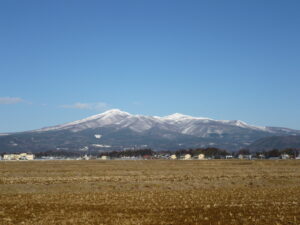
Hachimantai (八幡平) sits at around 1,614 meters (5,295 feet) above sea level, but don’t let the modest altitude fool you. This is not a simple mountain — it’s a sprawling plateau roughly 20 kilometers (12 miles) across, carpeted in subalpine marshes, volcanic pools, and dense beech forest. The landscape feels more like Iceland’s geothermal highlands than anything you’d associate with Japan, and that’s precisely what makes it so captivating.
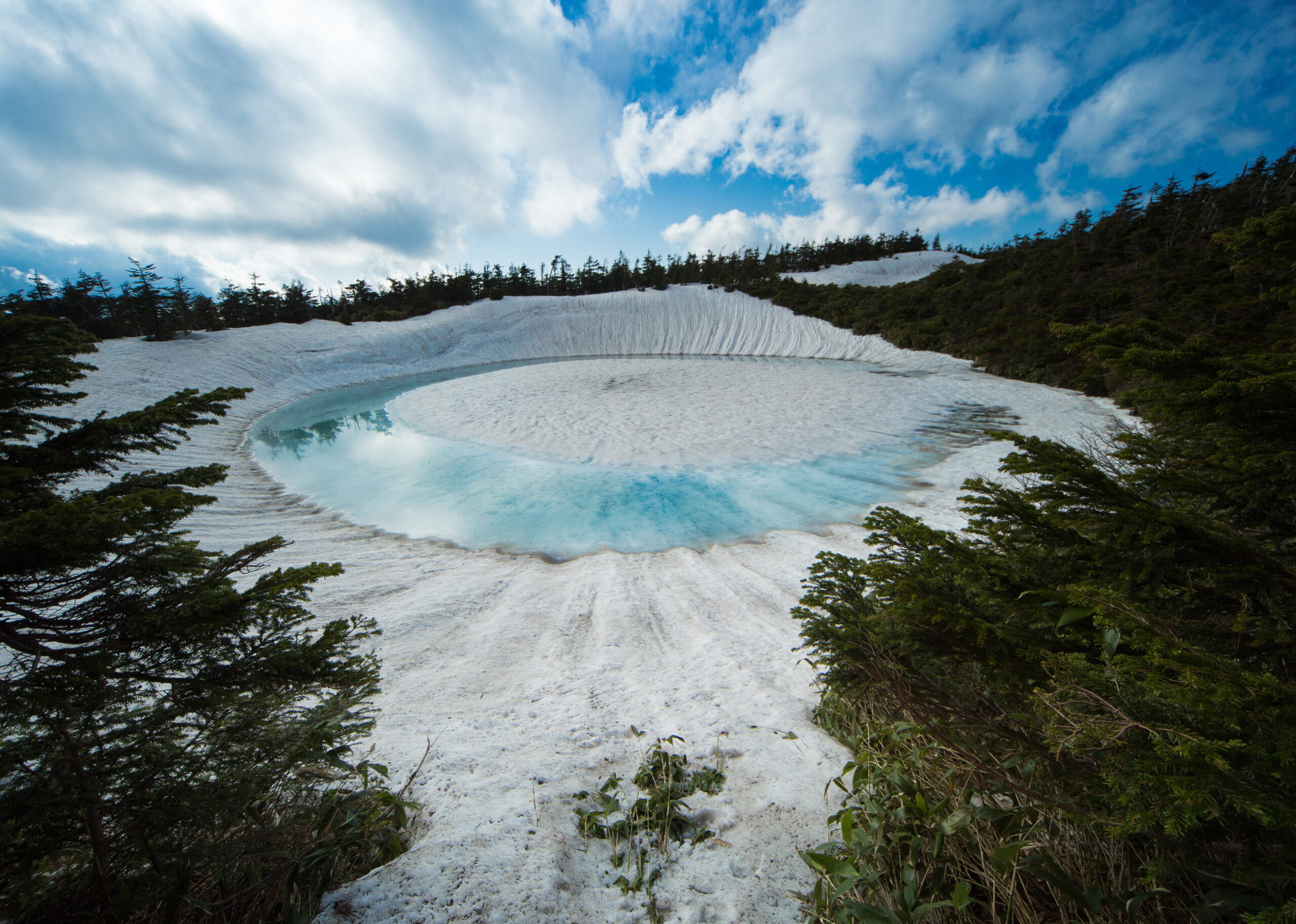
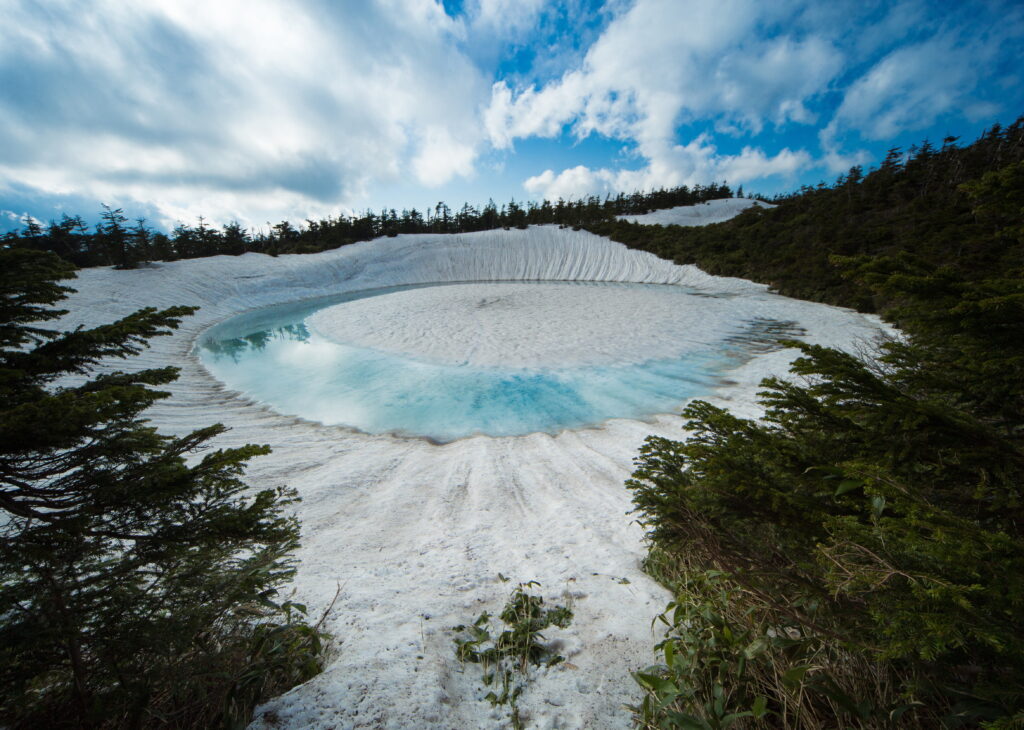
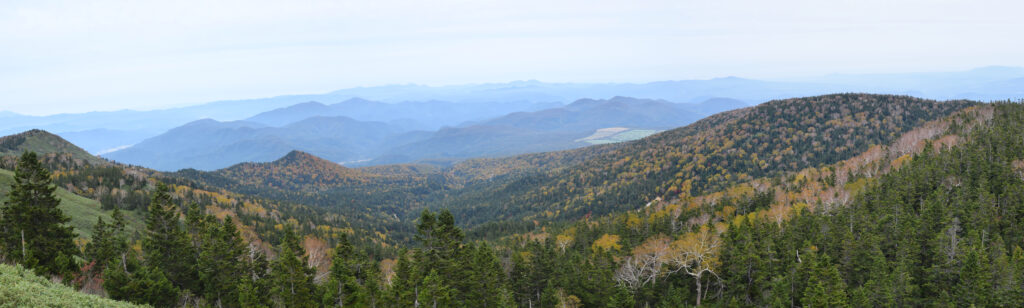
The plateau is most famous for two natural spectacles. In late May and early June, a snow-melt phenomenon called the “Dragon Eye” (竜の目, Ryū no me) appears at Kagami-numa — a circular crater lake where concentric rings of melting ice create a pattern that looks uncannily like an enormous iris staring up at the sky. Photographers and curious travelers drive from across Japan for the brief two-week window when the pattern is at its peak. Then, from late September through mid-October, Hachimantai undergoes one of Japan’s most dramatic autumn transformations: the mix of birch, beech, rowan, and dwarf pine turns the plateau into a mosaic of crimson, gold, and burnt orange that rivals anything in Nikko or Kyoto — with a fraction of the crowds.
Beyond its two star seasons, Hachimantai rewards year-round visitors. In winter, the Aspite Line (the scenic toll road crossing the plateau) closes to traffic and the area becomes a paradise for backcountry skiers and snowshoers. In summer, well-maintained hiking trails loop through wetland boardwalks and past steaming volcanic vents. And at any time of year, the surrounding valleys are dense with some of Japan’s finest onsen — particularly on the Iwate side, where Matsukawa Onsen and Goshogake Onsen tap directly into the volcanic heat beneath your feet.
Getting There from Tokyo and Sendai
Hachimantai is not the most straightforward destination in Tohoku — but that’s part of its charm, and the logistics are less daunting than they might initially appear.
By Shinkansen + Bus
- From Tokyo: Take the Tohoku Shinkansen to Morioka Station (approximately 2 hours 10 minutes; around ¥15,000 / ~$100 one way). From Morioka, buses operated by Iwate Kenpoku Bus (岩手県北バス) run to Hachimantai during the tourist season (late April to early November), taking about 1 hour 45 minutes and costing approximately ¥2,100 / ~$14. The JR Pass covers the shinkansen portion.
- From Sendai: Take the Tohoku Shinkansen north to Morioka (about 40 minutes; around ¥6,000 / ~$40), then connect to the Hachimantai bus as above.
- From Akita City: Buses run from Kita-Akita (鹿角市) direction to the plateau via the Towada-Hachimantai National Park route. Allow around 2.5–3 hours from Akita city. This route is less frequent and not always available in off-season; check with Akita Nakadori Bus.
By Rental Car (Strongly Recommended)
Honestly? Hachimantai really shines when you have a car. The Aspite Line (アスピーテライン, Route 341 on the Akita side / Route 23 on the Iwate side) is one of Japan’s most scenic alpine roads, and driving it at your own pace — pulling over for viewpoints, making spontaneous hot spring stops — is the way to fully experience the plateau. From Morioka, it’s about 1 hour 20 minutes by car. From Akita city, approximately 2 hours. Rental cars are readily available at Morioka Station; expect to pay ¥7,000–¥12,000 (~$47–$80) per day for a standard compact.
Note: The Aspite Line and Jukkoku Pass are toll roads on the summit section. The combined toll from Iwate side to Akita side is around ¥200–¥600 (~$1.50–$4), payable at the entrance gates. The roads are closed from approximately late November through late April due to heavy snow.
The Dragon Eye: Hachimantai’s Most Iconic Sight
If you’re planning a visit in late May or early June, move the Dragon Eye to the top of your list. Kagami-numa (鏡沼, “Mirror Pond”) is a small volcanic crater lake near the Hachimantai Summit Rest House, accessible via a 15-minute walk from the parking area. What makes it magical is the way the surrounding snow melts in spring: as the circular snowfield thaws from the center outward, it creates concentric rings of white ice and dark water that — particularly when viewed from the short trail above the lake — resembles an enormous reptilian eye peering up from the earth.
The phenomenon typically appears from late May through early June, and the best window for the “iris” pattern is usually a two-week period when the melting is at an intermediate stage — too early and the snow is uniform; too late and it’s completely melted. Local tourism offices post regular updates on the Hachimantai Tourism Association website (八幡平市観光協会), and social media hashtag searches for 八幡平 竜の目 will show you near-real-time photos from other visitors.
The hike to Kagami-numa is gentle (15 minutes each way, on a well-maintained trail) and combines beautifully with the main summit loop trail (see below). Arrive early — by 8 or 9am — to beat the weekend crowds and catch the best light. The parking area at the Hachimantai Summit Rest House fills up quickly on clear weekend mornings in peak Dragon Eye season, so a weekday visit is ideal if your schedule allows.
Hiking the Summit Loop Trail
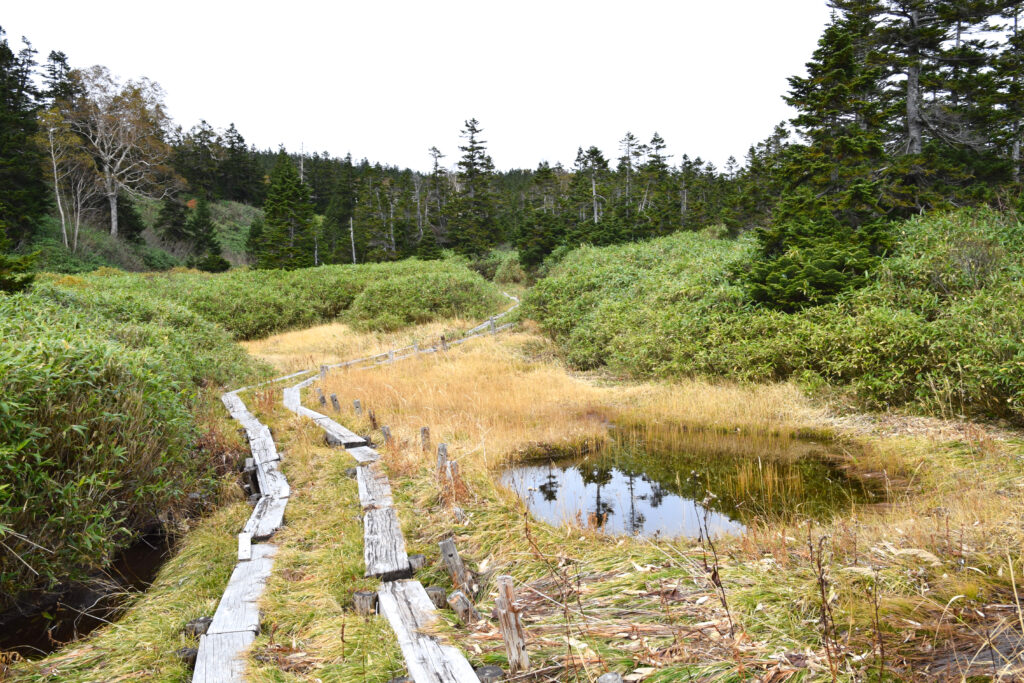
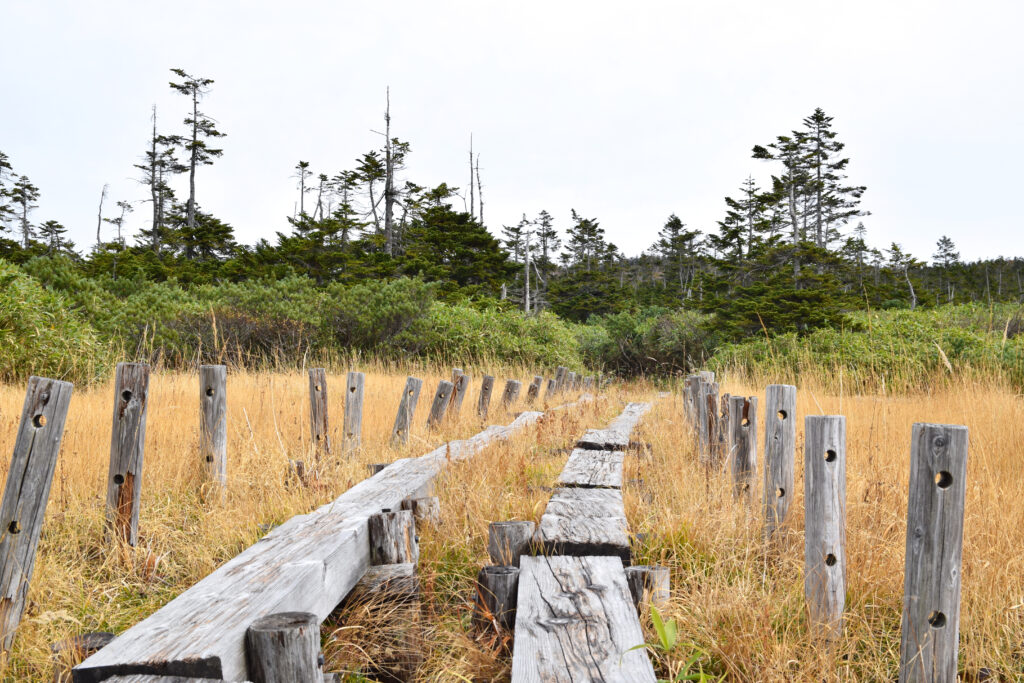
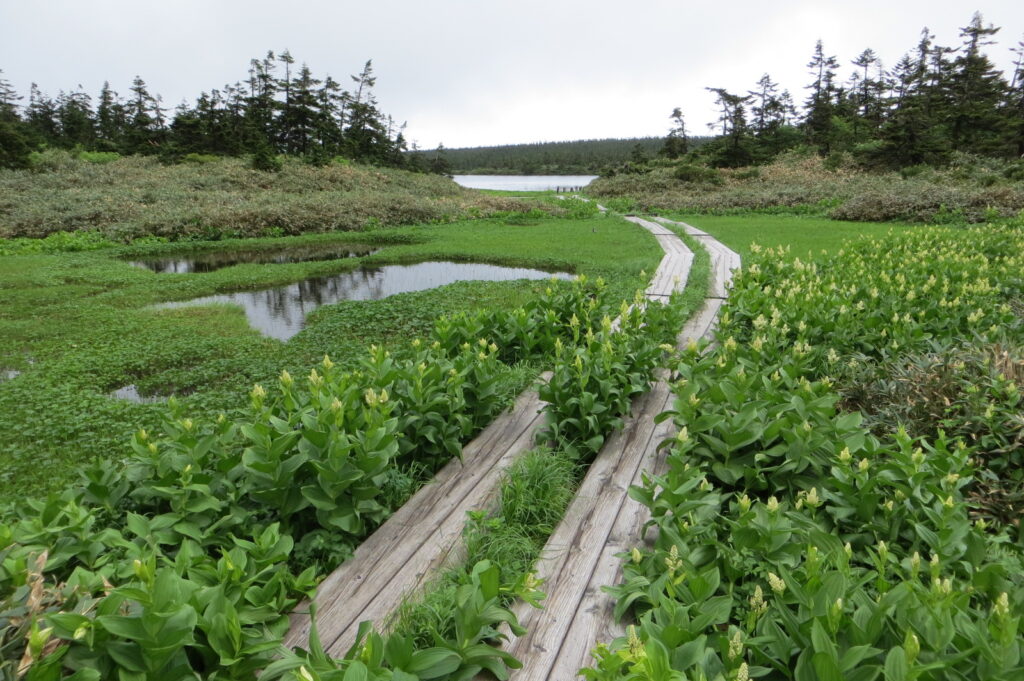
The classic Hachimantai plateau hike is the summit loop (山頂遊歩道), a roughly 3.1-kilometer (1.9-mile) circuit that can be completed comfortably in 1.5 to 2.5 hours depending on pace. The trail is well-signposted in Japanese and relatively easy, with boardwalks crossing the wetter sections of the plateau. It passes through several distinct landscape zones:
Hachimantai Summit (1,614m / 5,295ft): On clear days, the views from the summit extend across the volcanic highlands and, on exceptionally clear days, to the Pacific coast to the east and the Sea of Japan to the west. The summit marker is a popular photo spot.
Gama Numa & Fushi Numa Pond Area: The plateau is dotted with small volcanic ponds surrounded by wetland vegetation. In late June and July, cotton grass (ワタスゲ) blooms across the boggy areas in fluffy white clusters, and in late July, the purple flowers of Hana-shinobugusa add color to the marshes.
Fumarole Zones: The volcanic origins of the plateau are never far from the surface. Steam vents can be seen and smelled — that faint sulfuric tang is the reassuring confirmation that you’re walking on an active volcanic system. Keep to marked trails in these areas.
Trail conditions vary significantly by season. From late April to mid-May, snow can still cover parts of the trail — traction devices (microspikes) are recommended. In full summer (July–August), the trail is easy and accessible to most fitness levels. In autumn (late September–October), the foliage transforms the walk into something truly spectacular; early morning light through the golden birch canopy is not something you’ll forget easily.
Onsen: The Other Reason to Visit Hachimantai
The Hachimantai area sits directly above intense geothermal activity, and the result is a remarkable concentration of high-quality onsen within a small geographic area. The springs here are not the mild, clear waters you’ll find in many mainstream onsen towns — they are powerful, often milky or rust-colored mineral baths with genuinely therapeutic qualities. This is the real thing.
Goshogake Onsen (後生掛温泉)
Located on the Akita side of the plateau near the Aspite Line, Goshogake is one of Hachimantai’s most remarkable spots — a combination of a traditional onsen inn and an active volcanic park. The inn itself dates back centuries and sits in the middle of a steaming, bubbling geothermal field that you can explore on a 30-minute self-guided walking trail. Mud pools bubble, sulfurous steam vents hiss, and the ground is stained vivid yellows and reds by mineral deposits. It feels genuinely otherworldly. The onsen baths themselves are excellent — the inn offers both indoor and outdoor baths with various spring types including a famous mud bath (泥風呂, doroburo) in which you can coat yourself in warm mineral-rich mud. Day bathing is available for approximately ¥700 (~$5). Staying overnight at the rustic inn is highly recommended: rates run from about ¥14,000–¥22,000 (~$93–$147) per person including dinner and breakfast.
Matsukawa Onsen (松川温泉)
On the Iwate side, Matsukawa Onsen sits in a secluded forest valley where a river runs beside the ryokan and the air smells faintly of pine and sulfur. Three traditional ryokan operate here — Matsukawa Onsen Kyounkaku, Matsumisokan, and Tokomaden — and all offer day bathing. The springs are acidic sulfur water with a distinctive milky-white color. The outdoor baths (rotenburo) are among the best in the Hachimantai area: soaking in milky water surrounded by beech forest, listening to the river below, is an experience of rare tranquility. Day bathing costs approximately ¥500–¥700 (~$3–$5). Overnight stays at the ryokan typically cost ¥12,000–¥18,000 (~$80–$120) per person with two meals.
Fukenoyu Onsen (ふけの湯温泉)
This is perhaps the most dramatic of the Hachimantai onsen experiences. Fukenoyu is a centuries-old outdoor bath complex set in a geothermal field — the baths themselves sit amid steaming fumaroles, with volcanic steam rising from the ground all around you as you soak. The open-air baths have separate men’s and women’s sections with no roof — just the sky (and in winter, snowflakes). It is utterly wild and completely authentic. The source water is exceptionally hot at around 80°C / 176°F and is cooled to bathing temperature (around 42°C / 108°F) in the pools. Day bathing costs approximately ¥700 (~$5). Note: Fukenoyu is only accessible by car; it’s located on the Akita side of the Aspite Line, a short distance below the summit area.
Appi Kogen: World-Class Skiing on the Hachimantai Doorstep
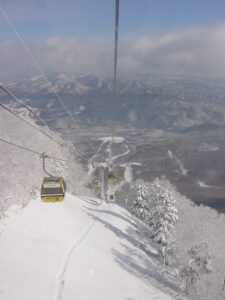
On the Iwate side of Hachimantai, Appi Kogen Ski Resort (安比高原スキー場) stands as one of Japan’s finest ski destinations — and one of its most underrated by international visitors. While Hokkaido’s Niseko has become internationally famous, Appi delivers comparable powder quality with a fraction of the foreign crowds and prices that still feel reasonable by international standards.
The resort receives an average of around 12 meters (40 feet) of snow per season, and the terrain — 21 runs across a vertical drop of about 780 meters (2,560 feet) — suits intermediate to advanced skiers and riders. The longest run stretches 5.5 kilometers (3.4 miles). Lift passes cost approximately ¥5,800 (~$39) for a day ticket. Equipment rental is available at the resort base for around ¥4,000–¥6,000 (~$27–$40) per day.
Appi is also excellent for non-skiers: the resort hotel is comfortable and modern, there are snowshoeing courses through the beech forest, and the hot springs at the base are a perfect post-ski reward. Access from Morioka is approximately 1 hour by car, or by direct resort bus from Morioka Station during the ski season. Resort hotels start from around ¥12,000 (~$80) per person per night with meals.
Best Time to Visit Hachimantai
- Spring (Late May – June): This is Dragon Eye season, and arguably the most unique time to visit. The summit area reopens as snow melts, wildflowers emerge, and the famous Kagami-numa iris pattern typically peaks in late May to early June. Temperatures at elevation are cool (8–15°C / 46–59°F), so dress in layers. The Aspite Line usually reopens in late April on the Akita side.
- Summer (July – August): The plateau is in full green, hiking conditions are excellent, and the onsen are particularly appealing after a day on the trails. Temperatures are mild at elevation (15–22°C / 59–72°F) even when the lowlands are hot. July and August see the most visitors, but crowds remain manageable by Tohoku standards.
- Autumn (Late September – Mid-October): Peak foliage season is typically late September to the first or second week of October, with the summit area changing earlier than the lower valleys. This is the busiest season — particularly for weekend visitors from Tohoku’s major cities — but still far quieter than famous foliage spots in other parts of Japan. The colors are genuinely world-class.
- Winter (December – March): The Aspite Line closes (usually late November through late April), so the plateau itself is inaccessible by road. However, Appi Kogen ski resort operates at full capacity, and Goshogake Onsen remains open for those willing to make the winding descent on the lower roads. This is a fantastic season for those combining Hachimantai onsen with skiing at Appi.
Where to Eat: Hachimantai’s Local Food Guide
The Hachimantai area spans two prefectures with distinct food traditions, which means you’re in for a treat. Akita and Iwate are both serious food destinations, and the region around Hachimantai delivers on local specialties in a way that feels authentic and unpretentious.
Kiritanpo (きりたんぽ)
Akita’s most famous dish — and one of Japan’s great comfort foods — is available throughout the Akita side of Hachimantai. Kiritanpo is made from freshly cooked rice that’s been mashed, formed around cedar skewers, and then either grilled over charcoal (delicious with miso paste, eaten as a snack) or simmered in a rich chicken stock hot pot (きりたんぽ鍋, kiritanpo nabe) with burdock root, maitake mushrooms, Japanese leek, and Hinai-dori chicken. The hot pot version is the one to order in the colder months — warming, hearty, and deeply satisfying. Most ryokan in the Akita-side onsen villages serve kiritanpo nabe as part of their dinner course.
Wanko Soba at the Iwate Side
On the Iwate side, you’re in the heartland of wanko soba territory. While the full wanko soba challenge (repeatedly refilled small bowls of buckwheat noodles, competing to eat as many as possible) is best experienced in Morioka, the surrounding restaurants serve excellent regular soba made from locally grown buckwheat. Look for handmade (手打ち, teuchi) soba restaurants near Hachimantai Kogen area; a modest bowl typically costs ¥800–¥1,200 (~$5–$8).
Oyster and Seafood at Summit Rest House
The Hachimantai Summit Rest House (八幡平山頂レストハウス) is a surprisingly good lunch stop. It serves warm dishes including soba, ramen, and seasonal specials — and given the elevation and volcanic backdrop, eating here has an undeniable atmosphere. Open during the tourist season (late April through late November), hours approximately 8:30am–4:30pm. Expect to pay ¥800–¥1,500 (~$5–$10) for a meal.
Ryokan Kaiseki Dinners
If you’re staying overnight at any of the Hachimantai area onsen ryokan — and you should — the dinner is not to be skipped. Traditional kaiseki-style multi-course meals at places like Goshogake Onsen Inn or Matsukawa Onsen ryokan feature locally sourced ingredients: mountain vegetables (sansai), game meats in season, Akita Komachi rice, freshwater fish from the local rivers, and sake from nearby breweries. This is the kind of meal that makes you rethink what “dinner” can be.
Where to Stay
Budget (Under ¥8,000 / $55 per night)
Budget accommodation options are limited in the immediate Hachimantai area — this is primarily ryokan and hotel territory. For budget travelers, the most practical approach is to base yourself in Morioka or Kazuno (鹿角市) on the Akita side and make day trips to the plateau. In Morioka, budget hotels and hostels cluster around the station area starting from around ¥3,500–¥6,000 (~$23–$40) per night. Morioka Guest House Tabi-no-ne is a popular choice among international backpackers, with dormitory beds from around ¥3,200 (~$21) and private rooms from ¥6,500 (~$43).
Mid-Range (¥8,000–¥20,000 / $55–$135 per night)
Appi Kogen Resort Hotels: The resort hotels at Appi Kogen — particularly Appi Grand Hotel — offer comfortable Western and Japanese rooms, multiple onsen baths, and convenient access to both skiing (in winter) and the plateau trails. Rates typically run ¥12,000–¥18,000 (~$80–$120) per person with dinner and breakfast. This is excellent value for the quality.
Matsukawa Onsen Kyounkaku (松川温泉峡雲閣): A traditional ryokan in the forest valley of Matsukawa Onsen, with excellent hot springs, simple but beautiful rooms, and home-cooked ryokan meals. Rates approximately ¥14,000–¥18,000 (~$93–$120) per person including two meals.
Luxury (¥20,000+ / $135+ per night)
Goshogake Onsen (後生掛温泉): Staying at the legendary Goshogake inn is a genuinely special experience. The rooms are traditional and atmospheric, the volcanic field setting is unforgettable, and the various spring baths — including the famous mud bath — make it worth every yen. Rates from approximately ¥20,000–¥28,000 (~$133–$187) per person including two meals. Book well in advance for autumn foliage and Dragon Eye seasons.
Practical Tips for Visiting Hachimantai
- Car is king: While the plateau summit is accessible by seasonal bus from Morioka, a rental car transforms this destination. The Aspite Line scenic drive is itself one of the highlights, and the scattered onsen and viewpoints between stops are only accessible with your own transport.
- Check road opening dates: The Aspite Line (アスピーテライン) and Jukkoku Pass (十和田八幡平樹海ライン) close annually for winter. Opening dates vary by snowfall — typically late April on the Akita side, and late April to early May on the Iwate side. Always verify current conditions before your trip at the Hachimantai Tourist Information Center or the prefectural road information website.
- Dragon Eye timing is everything: The Kagami-numa Dragon Eye phenomenon has a roughly 2-week peak window, typically late May to early June. Check the Hachimantai Tourism Association website or their Instagram for real-time updates before booking your trip dates.
- Autumn foliage peaks early: At elevation, peak foliage on the plateau typically occurs late September to early October — up to two weeks earlier than popular lower-altitude spots. If you’re planning a Tohoku autumn trip, pair Hachimantai with lower-elevation spots like Naruko Gorge to catch two distinct foliage windows.
- Bring cash: Most of the onsen ryokan and smaller restaurants in the Hachimantai area are cash-only or have limited card acceptance. Withdraw yen in Morioka or Kazuno before heading to the plateau.
- Dress for temperature swings: Even in summer, temperatures at 1,600m / 5,250ft can drop to 10°C / 50°F at night and on overcast days. Always bring a windproof layer and a light fleece even if you’re visiting in July.
- Onsen etiquette basics: All Japanese onsen require you to bathe nude, wash thoroughly at the provided shower stations before entering the baths, and keep your towel out of the water. Tattoos are problematic at some facilities (though the Hachimantai area tends to be more lenient than urban onsen). When in doubt, ask in advance.
- The Aspite Line toll: There is a small toll for driving the summit section of the Aspite Line. Keep cash handy — approximately ¥200–¥300 (~$1.50–$2) per toll gate.
- Day trip vs. overnight: You can technically visit Hachimantai on a day trip from Morioka by rental car, but an overnight stay at one of the plateau onsen is strongly recommended — you’ll want to experience the soaking, the ryokan dinner, and the morning light on the plateau.
- Wildlife awareness: The Hachimantai area is genuine wilderness. Bears (ツキノワグマ, Asiatic black bears) are present in the forests surrounding the plateau. Make noise while hiking in forested sections, especially in early morning or at dusk. Hike in groups when possible. Bear bells are available for purchase at tourist shops in Morioka.
Sample 2-Day Hachimantai Itinerary
Day 1: Arrival and Iwate Side
Morning: Depart Morioka by rental car (or seasonal bus for summit area only). Drive the Jukkoku Pass scenic route through the Iwate-side beech forests. Stop at Matsukawa Onsen for a morning soak and coffee — a short detour off the main road.
Midday: Continue up to the Hachimantai Summit Rest House. Have lunch (soba or ramen), then set out on the summit loop trail (1.5–2.5 hours). Visit Kagami-numa (Dragon Eye pond) if your timing aligns with late May/early June, or enjoy the wetland and pond scenery in summer, or the blazing foliage in autumn.
Afternoon: Cross to the Akita side via the Aspite Line. Stop at Fukenoyu Onsen for a dramatic outdoor soak in the volcanic field. Continue to your accommodation — either Goshogake Onsen or the Appi Kogen area.
Evening: Multi-course kaiseki dinner at your ryokan, followed by a second soak in the inn’s private baths before bed.
Day 2: Volcanic Fields and Return
Morning: If staying at Goshogake, walk the on-site volcanic field trail early (opens around 8am) — the steam and bubbling mud pools are especially atmospheric in the morning light. Have a ryokan breakfast of rice, grilled fish, pickles, and miso soup.
Midday: Check out and drive to Toshichi Onsen (十和田温泉) area or the Hachimantai Kogen area for a final walk. The 1.2km Ōnuma Nature Walk (大沼自然観察路) near Ōnuma Swamp on the Akita side is a peaceful marsh boardwalk surrounded by wetland plants.
Afternoon: Return to Morioka (1.5 hours by car) or Kazuno-Hanawa Station by bus for your onward journey. If time allows, stop in Kazuno city for a bowl of Kiritanpo nabe for lunch before your departure.
Related Articles You Might Enjoy
- Akita Nairiku Jukan Railway: Japan’s Most Beautiful Secret Train Journey Through the Mountains
- Akita Dog & Odate: Meeting Japan’s Most Loyal Breed in Its Birthplace
- Lake Tazawa Akita: Complete Travel Guide to Japan’s Deepest & Most Magical Lake
- Akita City Guide: Samurai Castles, World-Class Sake & Local Flavors in Tohoku’s Wildest Prefecture
- Nishimonai Bon Odori, Akita: Japan’s Most Mysterious Summer Festival — Complete Guide
Final Thoughts
Hachimantai represents everything that makes Tohoku special: genuine wilderness, authentic cultural experiences, world-class natural phenomena, and a complete absence of the tourist-trail crowds that have come to define Japan travel. Whether you’re here for the surreal Dragon Eye in late spring, the volcanic onsen that seem to emerge from another geological era, or the autumn foliage that turns the plateau into a living painting — or all three — Hachimantai has a way of surprising even seasoned Japan travelers with how much it delivers.
The logistics require a bit more planning than a standard shinkansen hop, but that’s the point. Hachimantai earns its discovery. Once you’ve soaked in the sulfurous outdoor baths while steam rises from the volcanic earth around you, eaten your fill of kiritanpo nabe in a centuries-old inn, and watched dawn light move across the golden plateau, you’ll understand why those who find this place rarely stop talking about it — and keep coming back.
Got questions about planning your Tohoku trip, or spotted something we missed? We’d love to hear from you — drop us a message here.


コメント